If you’re reading this, you have already heard about The Legend of Zelda: Echoes of Wisdom, and have likely seen the trailer. The series has finally hit a major milestone: we get to play as the titular Princess Zelda herself. So why did this happen now? I think we can trace a direct line from a design philosophy called “multiplicative design”, first seen in Breath of the Wild, to a playable Zelda.
Let’s dig in.
Form follows function for Shigeru Miyamoto
Before we can explore the concept of multiplicative design and how it relates to Echoes of Wisdom, we need to understand how the designers at Nintendo approach their projects. We’ll start with Zelda series creator Shigeru Miyamoto and the first team he led as a Producer at Nintendo: Research & Development 4 (R&D4).
Miyamoto had already seen success as the director of games like Donkey Kong, Mario Bros., and Excitebike, so when R&D4 was formed he was appointed Producer over its projects. He deeply defined the group’s game design aesthetic; R&D4 was essentially Miyamoto’s team within Nintendo. Their first two games were Super Mario Bros. and The Legend of Zelda. In the decades since, the group has grown and had many names; the longest-held name was EAD (Entertainment, Analysis, & Development), which is how I’ll refer to them from here onwards. Looking back, EAD was responsible for most of the series that come to mind when we hear “Nintendo”: Zelda, Mario, Mario Kart, Pikmin, Animal Crossing, Star Fox, Wii Sports, Splatoon, and even F-Zero.
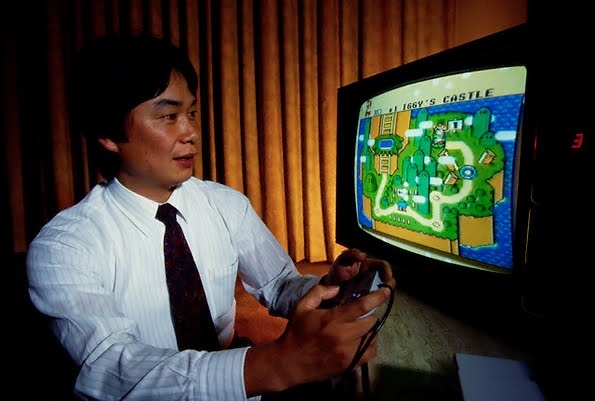
Shigeru Miyamoto. Hired at Nintendo in 1977, and directed Donkey Kong in 1981. He went on to spearhead the creation of the Mario and Zelda franchises, and lead decades of game development at Nintendo. Image credit: [1]
Much of EAD’s success can be traced to the design aesthetic instilled in them by Miyamoto. As a developer, Miyamoto is very focused on two major pillars: the game mechanics, and the characters within them. One or the other are usually the starting point for a game.
For his first game, Donkey Kong, he started with the Popeye characters – yes, the classic American cartoon – and designed a game that fit them. When the Popeye license fell through he carefully designed new characters around the needs of his game instead. He took a form-follows-function approach to designing the player character (who would later be named “Mario”): overalls made his arms visually distinct from his torso, a hat meant that they didn’t have to depict complex hair, and a mustache meant that they didn’t need to draw a mouth.[2] Link’s design in the first Zelda title followed similar principles. Link’s brown arms contrasted with the green tunic to make his limbs more distinct, and the hat allowed them to simplify his hair.
The second pillar of Miyamoto’s design aesthetic is characters. Though these characters’ original designs were born from necessity, Miyamoto is quite protective of their core qualities and brand. He sees them as mascots, as the representatives of his games, and their identities are very important to him. There are many stories in interviews about Miyamoto being resistant to changes to the themes or details of his characters.
Nintendo EAD follows Miyamoto’s lead for both of these pillars. The games made by EAD usually start with a mechanic or experiential goal, and then lean into the characters that best match that goal. For example, the goal of Wii Sports was to get the whole family to play together in the living room.[3] They decided that they needed entirely new types of characters to achieve that, rather than using an existing series like Mario. The starting point of Super Mario Galaxy was the idea to use spherical worlds to ensure that the camera was never obstructed. An existing character, Mario, was a perfect fit.[4]
Zelda titles are no exception. According to Eiji Aonuma, producer of the series since 2004, the starting point for the Link’s Awakening remake was a goal to make a game where players could design their own dungeons. The idea to use Link’s Awakening came afterwards. He said that they thought that Link’s Awakening would be a “perfect fit” because “every room is about the same size.”[5]
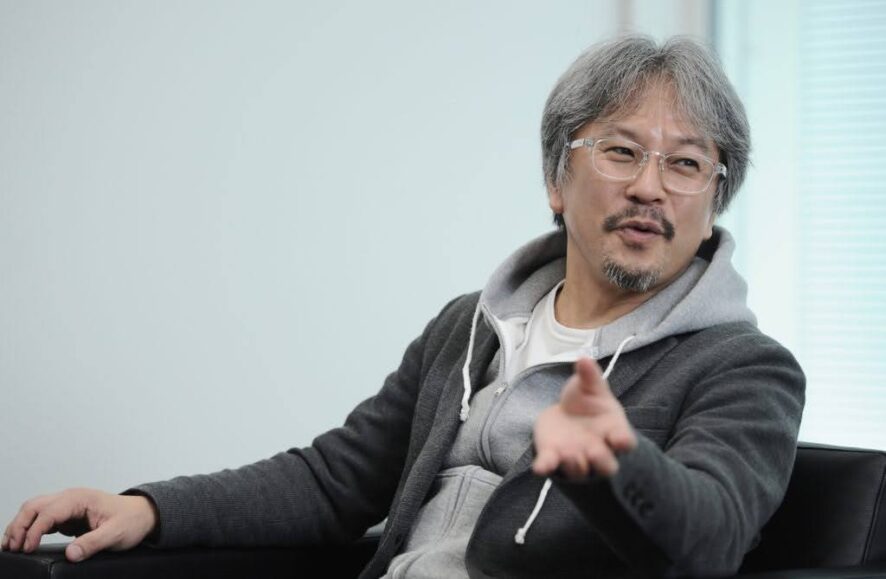
Eiji Aonuma. Hired at Nintendo in 1988, his first Zelda role was as Dungeon Director for Ocarina of Time. He took over as Zelda series producer around 2004, and has led the franchise ever since. Image credit: [6]
Breath of the Wild’s puzzle revolution
Now let’s fast forward and look at how these concepts were applied to the Zelda series to create Breath of the Wild from first principles.
According to Aonuma, Ocarina of Time set the formula for 3D Zelda games for many years.[7] In contrast, the Breath of the Wild team chose to look to the original themes of the Zelda series instead of using Ocarina of Time as a blueprint.
Miyamoto has frequently spoken about the themes of the first Zelda. He has referred to it as a game “about hiking”[8] and about a “boy becoming a hero”[9]. He’s described it as being about treasure hunting[10], and as a game where players “need to think about what to do next”.[11]
For more insight into the series’ themes, we can also look to Hidemaro Fujibayashi. He was the director of many Zelda titles, including Oracle of Ages and Oracle of Seasons, Skyward Sword, and Breath of the Wild. He says that the “universal experience” at the heart of the series is the feeling you get when you solve a puzzle, and that the Zelda games are built to “treasure that feeling.”[12]
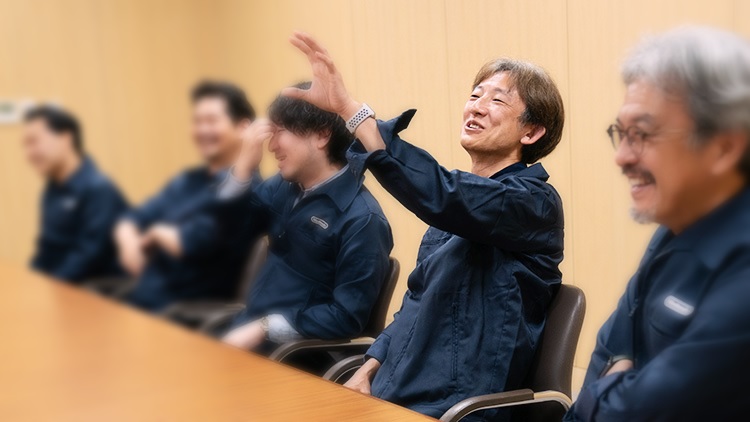
Hidemaro Fujibayashi. His first Zelda role was as director of the Oracles, when he worked at Capcom. He joined Nintendo around 2005, and later directed games like Skyward Sword, Breath of the Wild, and Tears of the Kingdom. Image credit: [13]
How Zelda titles achieve these goals and feelings has varied over time. To understand multiplicative design, let’s look at puzzles. In Ocarina of Time, almost every puzzle had a single solution. Puzzles were built from one-off mechanics that were usually hard-wired by designers to have specific effects, or placed in just the right spot to conveniently allow players to overcome obstacles. Examples include pushing blocks, lighting torches, or using wooden posts as Hookshot targets. Solving a puzzle was usually a matter of figuring out which mechanics you had to use, where to use them, and in what order to use them.
Part of Fujibayashi’s vision for Breath of the Wild was to change this puzzle-solving structure: instead of playing “within the confines of a pre-prepared mechanism”, he wanted to allow the player to “actively engage with the game.” He said that in past Zelda titles, “The objects that made up each of these puzzles were made specifically for those puzzles.”[14]
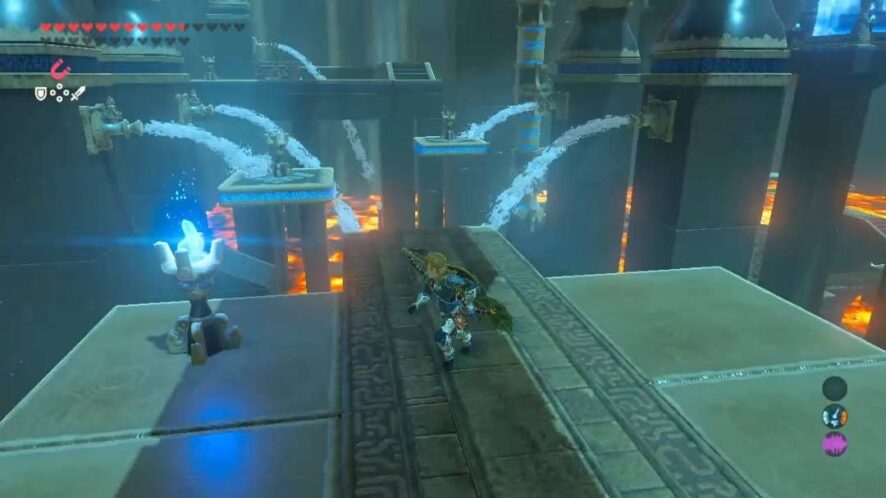
The solution the Breath of the Wild team landed on was to instead make “objects react to the player’s action”, and to allow “the objects themselves [to] also influence each other.” By taking an action like setting fire to grass, causing wind to blow, or rolling logs around, players could cause domino effects or set up new situations. Nintendo achieved this by embracing the freedom of simulated physics for all gameplay objects, and by creating what they called a rule-based chemistry engine to govern how objects could change each others’ state. Elemental effects like fire, wind, and water were driven by this chemistry engine. With these systems they were able to ditch puzzles that had fixed solutions.[14]
Instead, technical director Takuhiro Dohta said that Breath of the Wild was “a world where combining simple elements could produce complex results”, and that their team wanted players to “have fun thinking up and trying solutions on their own.”[14]
Fujibayashi called this philosophy multiplicative design, contrasted against the old philosophy that he called additive design.[14]
This shift in philosophy impacted many things. It made Ocarina-stye dungeons, built on additive design, difficult to design and integrate into the game. It reduced the odds of getting stuck on a puzzle, because players could find or imagine their own solutions–and that helped make Breath of the Wild the most approachable Zelda game since the series went 3D. These changes led to numerous player videos and imaginative play, even years after the release of the game.
After Tears of the Kingdom, Eiji Aonuma was asked what he thought about fans who missed the older style of additive puzzle design. He replied that games where the player needs to “follow a specific set of steps” were “kind of the games of the past.” He said that the games of today can “accept a player’s own decisions and give them the freedom to flexibly proceed.”[15] In other words, we should expect Zelda titles to stick to the multiplicative design philosophy for the foreseeable future.
The echo mechanic carries the torch
Which brings us to the newly revealed Echoes of Wisdom. The trailer highlighted a new mechanic, the ability to copy and create “echoes”:[16]
Echoes seem to be Zelda’s main method of interacting with the world, rather than wielding a weapon like Link.
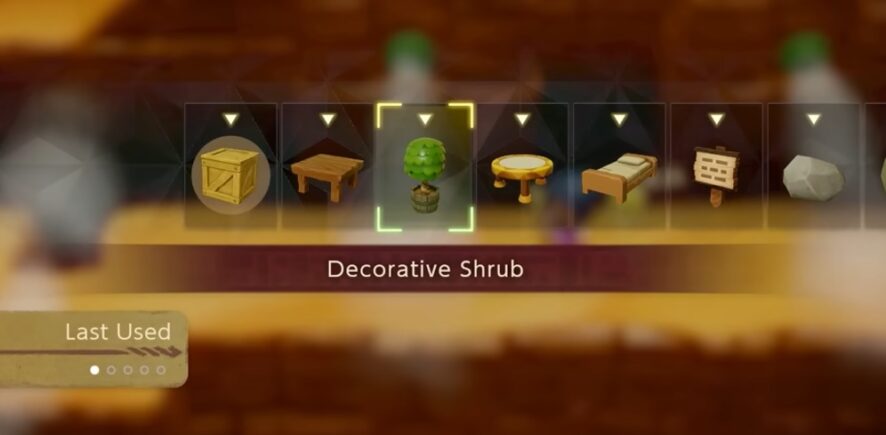
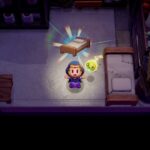
Zelda has the ability to copy objects she encounters in the world. This appears to add them to a permanent inventory of echoes.
Zelda can recreate the copied objects from her inventory at locations of the player’s choosing, but there does appear to be a limit to how many she can create at a time.
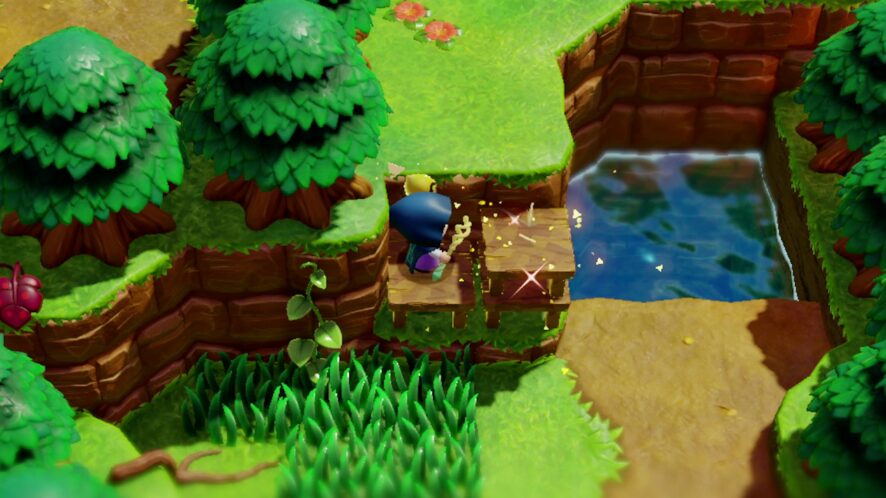
The trailer shows Zelda creating echoes of furniture, rocks, water, enemies, and more.
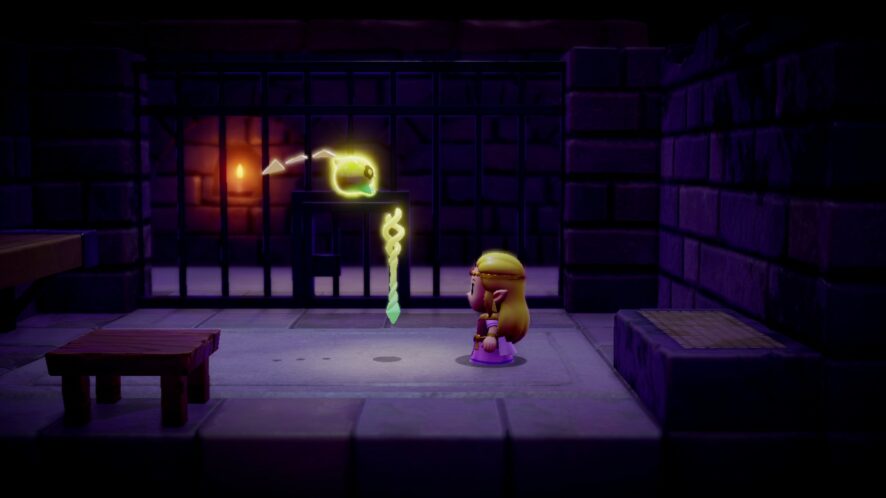
When Zelda creates echoes of monsters, they fight for her.
Right away we can see that this system provides a lot of freedom to approach puzzles, fight enemies, and solve problems in different ways. The echoes mechanic is quite different from the physics and chemistry systems of Breath of the Wild, and from the construction system in Tears of the Kingdom, but it follows the same underlying principles: the player can affect objects in the world in a variety of ways, and those objects affect each other. This mechanic should allow players to cause domino effects or set up new situations.
In the trailer, we see a bunch of different interactions between echoes of objects:
Furniture being stacked on top of one another.
Wooden boxes being pushed by wind.
A heavy planter not being pushed by wind.
Water being added to an already-placed water echo, causing it to extend upwards.
Food being placed to attract monsters.
Echoes of monsters, complete with behaviors and actions.
A candle-like monster setting fire to grass, which then spread.
We can infer that objects have a variety of physical properties such as size, shape, and weight. We can also infer that there are elemental interactions and forces: water had different rules than solid furniture, some objects were flammable, and wind exerted force on objects that had a different outcome depending on their weight.
In short, the echo mechanic is a clear continuation of the multiplicative design philosophy.
Zelda as the protagonist
Why does all of this lead to Zelda as the playable protagonist in Echoes of Wisdom? It seems likely that the starting point for Echoes of Wisdom was something like “bringing multiplicative design to a top-down Zelda”, and their answer was the echoes system. That would be the “function” in EAD’s form-follows-function studio culture.
My biggest assumption in this article is this: I suspect that after designing the echoes system, and deciding that it had all the properties they were looking for in a top-down take on multiplicative design, they found that sword gameplay was unnecessary. A distraction from the real mechanical star of the show. They realized that they wanted to cut the sword.
If so, that would run right into one of the other pillars of Miyamoto’s design aesthetic: character identities are important and must be respected. Is Link still Link without a sword, or is that an indelible part of his identity? Does a whole Zelda game featuring Link with no sword feel wrong, or discordant with everyone’s mental picture of the character? Link has wielded other weapons and tools before, but in every Zelda title his truest expression is as an adventurer who wields a sword.
So they’ve found a strong concept for a Zelda game, a concept that works better without a sword, and you can’t respect the character of Link without a sword. What to do?
One option would be to pivot to a different IP altogether. Maybe even a new series! In the past Nintendo has swapped the IP for game concepts to make form better match function. For example, Captain Toad: Treasure Tracker was originally pitched as a Zelda game because (at the time) Link didn’t jump and “not jumping” was a core part of the game’s concept. That pitch was vetoed by Miyamoto, and they swapped to the Mario IP and used Toad instead.[17] Another example is Splatoon, the newest jewel in Nintendo’s crown. They considered using Mario characters for it, before deciding that the game concept would be better served as a new IP.[18]
But there is a viable Zelda protagonist: Zelda herself! Wielding melee weapons is not part of her identity. Wielding magic and solving problems with her brains – and wisdom – are. She’s a perfect fit! Nintendo has done this with Princess Zelda before, too. In Spirit Tracks, they came up with the plan of having an allied character possess the Phantom, and only afterwards did they decide that Zelda was the right fit for that role.[19]
Seven months ago Aonuma was asked if they’d ever consider making Zelda the protagonist of a Zelda game. This would have been late in production for Echoes of Wisdom. He must have had a hard time keeping a straight face when he said “I think there’s always room for thinking about this type of thing”, and that there may be “some sort of possibility for something like that in the future.”
In the end, playable Zelda is a direct consequence of decades of history and of Breath of the Wild’s multiplicative design philosophy continuing on at Nintendo. She is a perfect form to slot into the function. It promises to be a very different take on what the Zelda series is and can be, while honoring what it has always been. I can’t wait to play it.
[14] Fujibayashu, Hidemaro, Takuhiro Dohta, and Satoru Takizawa. 2017. “Breaking Conventions with The Legend of Zelda: Breath of the Wild.” Youtube.com. https://www.youtube.com/watch?v=QyMsF31NdNc.


 by Max Nichols on July 15, 2024