Spoiler Warning:
The rest of this article contains significant spoilers for Tears of the Kingdom about the story, gameplay mechanics, etc. that you might not wish to see. Continue reading at your own risk.
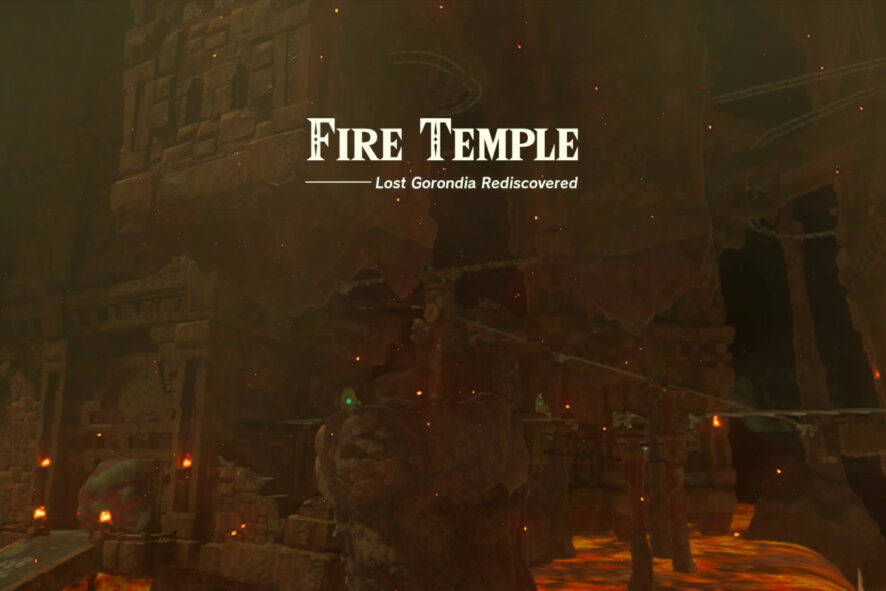
Tears of the Kingdom brought several unexpected changes from its predecessor, Breath of the Wild. One of the changes that many fans, myself included, were hoping for was more unique dungeons than those in Breath of the Wild. Fortunately, the developers definitely delivered and we got some great dungeons in Tears of the Kingdom. My personal favorite from the new game was the volcanic Fire Temple.
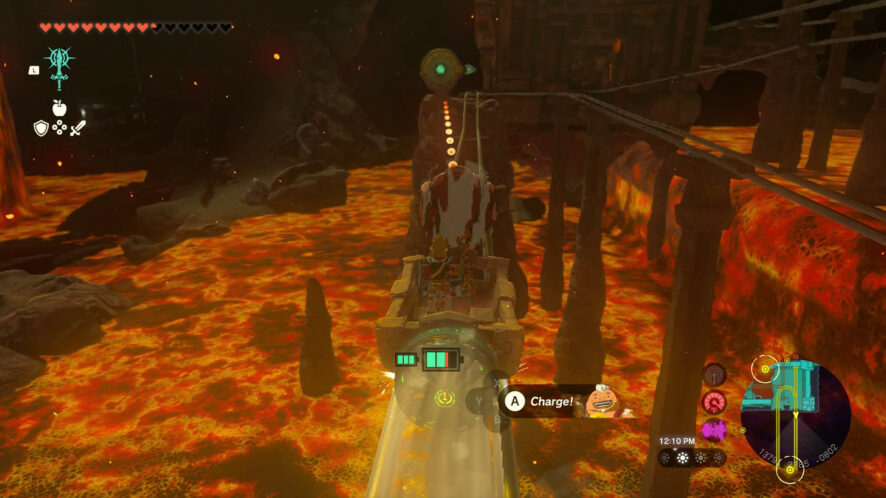
After the Hero of the Wild recruits Yunobo into his party, they have to travel deep beneath Death Mountain to find the Fire Temple. This ancient temple is partially submerged in a lake of lava, making it deadly to traverse without the assistance of some fireproof elixirs, or some flame resistant armor. The mine is said to be built by the Gorons ages ago, and is one of several mines that can be found in The Depths. It is a massive, open structure with many floors that are connected by mine cart tracks, because stairs would be too easy.
The boss room door is locked by five giant padlocks that can only be opened by ringing five gongs, each connected to a padlock, across the dungeon. The gongs are too thick for our short hero Link to activate. Instead he must use the new ability that Yunobo brings: Yunobo’s Power of Fire. With this new ability, Yunobo can roll in ball and fire himself at high speeds at the gongs in order to activate them.
The fire temple utilizes this new ability in its design in other ways too. There are several otherwise-unbreakable rocks that only Yunobo can destroy. Yunobo can also ride on the front of the mine carts like a cannon and can be used to hit obstacles or enemies.
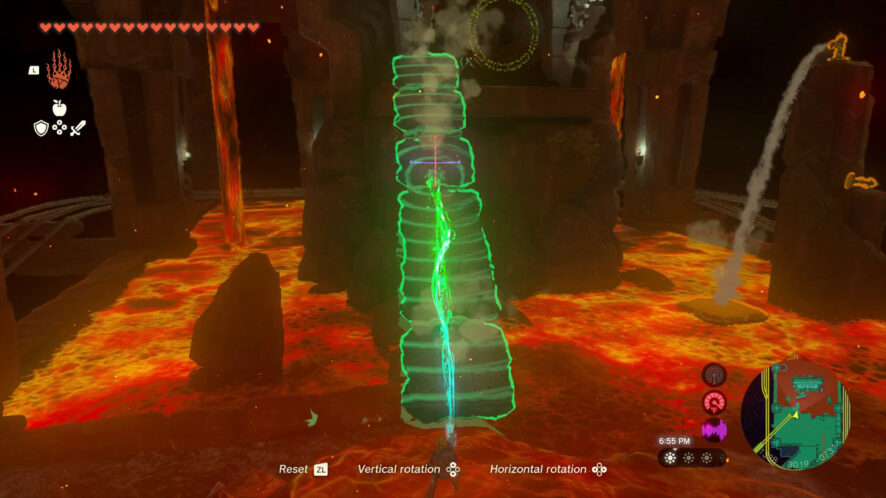
The hydrant Zonai Device also proves to be a mighty asset in the Fire Temple. Turns out this simple water hose is good for putting out fires. Since the dungeon is covered in lava, the Hydrant can cool the lava into convenient square platforms for traversing the the dungeon floor.
This dungeon is my favorite in Tears of the Kingdom. I love Zelda dungeons that require the player to use their navigational and spacial awareness skills, which the Fire Temple absolutely does. Some dungeons in the Zelda series are rather straight-forward, having the player going room-to-room, dealing with obstacles and enemies in a linear fashion. While there is nothing wrong with that design, I personally prefer the open-ended dungeons, much like the Fire Temple. The network of interconnected mine cart tracks require the player to plan their routes, but also translate their 2-D map into the 3-D environment. It provides a mental workout that I find strangely enjoyable, as it keeps my mind active and adds to the gameplay experience.
Moreover, this dungeon works harmoniously with Tears of the Kingdom’s core design – there is always multiple solutions to every problem. The floor plan of this dungeon is mostly open, meaning there is a lack of actual walls and ceilings. The player, myself included, can use the glider and Tulin’s wind (if you’ve already completed the Wind Temple) to reach places a mine cart can’t. You can also use Ascend to avoid some of the non-climbable walls. Or you can just build the classic hover bike and go wherever you want.
There are so many paths, just like there is always more than one way up Death Mountain – and that’s what I love about this dungeon.
After Yunobo and Link finish their dungeon crawl, smashing all five gongs and opening the padlocks, the boss door is open. The final boss of this dungeon is a decent one, the Scourge of the Fire Temple – Marbled Ghoma. This crustacean and arachnid-like creature is covered in hard rock, which is Yunobo’s specialty. Yunobo will smash the aberration’s legs, then Link will follow up by attacking the Ghoma’s unprotected eye. Once the monster has been felled, Link gets a heart container, Yunobo gets a lore-dump about his ancestor, and the Fire Temple is officially cleared.

For me, the Fire Temple encapsulates the essence of what makes Zelda dungeons so memorable. It has a perfect blend of spatial awareness, inventive problem-solving, and a dash of fun combat — a testament to the developer’s abilities to keep the franchise fresh, while also staying true to its core principles. It exemplifies this series’ enduring appeal, offering a fun and freeing experience that Zelda fans, new and old, can appreciate.