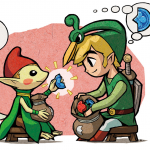
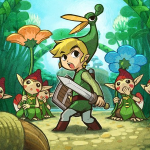
Informed that only Melari can reforge the Picori Blade and restore the hope of saving Princess Zelda, Link treks Mt. Crenel and enters Melari’s Mine seeking assistance. Here, he meets the acquaintance of the Mountain Minish, seven students who followed Melari to learn metal craft and mine for Kinstones. In a show of their manliness, these miniature miners sing a hearty song signifying that they are full-fledged Mountain Minish (anyone else getting major Snow White and the Seven Dwarfs vibes?). Of the conversations Link has with the miners, one particularly stands out. At first, it seems to indicate how proud yet absurd this worker was, but upon further thought, reflects more on the social structure of the mine and the character’s complete understanding of his place in it.
In the center of the mine, three Minish stand around a table as a hearth burns bright with red-hot flame, waiting to mold metal into weapons or tools. It’s obvious that the hulking figure on the left side of the table is Melari, the head honcho. Who are the others? On the bottom right, after interrupting the fellow’s manly song by asking for his name, Link instead learns that this gentleman happens to be the third-best of the Minish metalsmiths. As his title endows, he is afforded the honor of “makin’ swords with the boss.” After Link speaks with Melari, the third-best metalsmith sets to work reforging the sword upon which the fate of Hyrule rests.
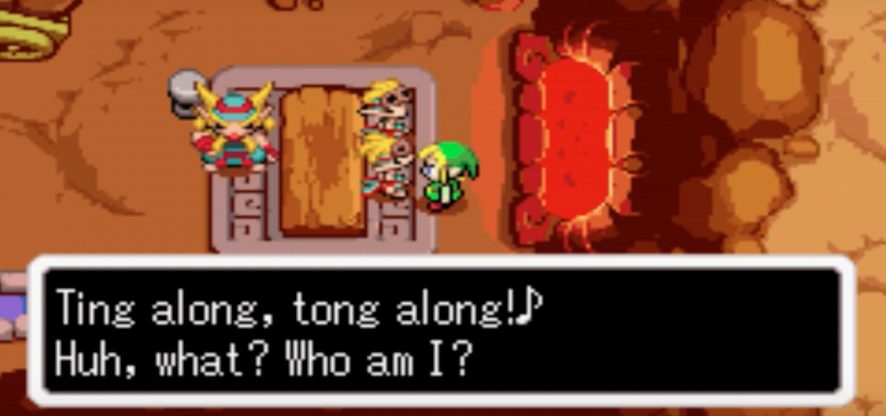
My first reaction to his introduction was to scoff. He defines himself first and foremost by his status within the mine’s hierarchy, which, by my calculations (three out of eight), is only slightly above average. Clearly, his rank is so important to him he feels no need to give his actual name. His unexpected response comes off as haughty and perhaps a way to highlight Link’s ignorance of the ways of the mine.
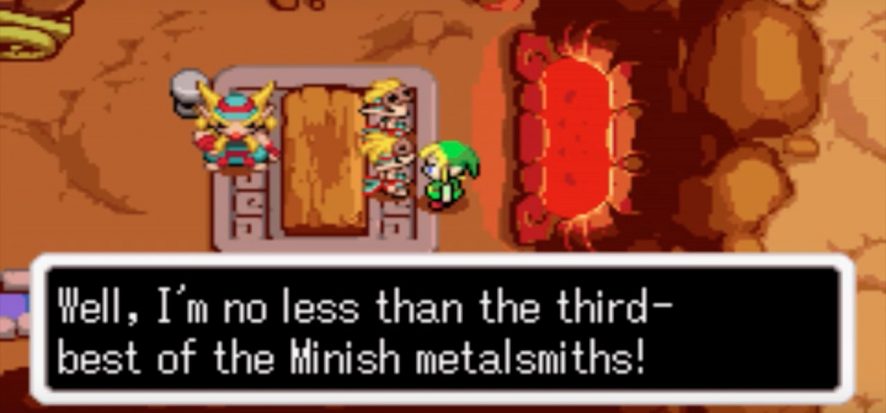
As I thought longer on this, my opinion changed. The mine’s operation appears to be a well-delineated meritocracy where those with the best skills have the most important jobs. And where life revolves around your trade, it only makes sense to tie your sense of self-worth by how good you are at it. Further, no jealousy seems to come across in his voice. He knows his position exactly — what he is and what he isn’t. Even as third-best, he has a crucial role to play in the mine and in Link’s quest to save Zelda. Also, third is nothing to laugh at when the pool of competition is elite, as appears to be the case in this mine where only eight toil. No one should look down on an Olympic bronze medalist.
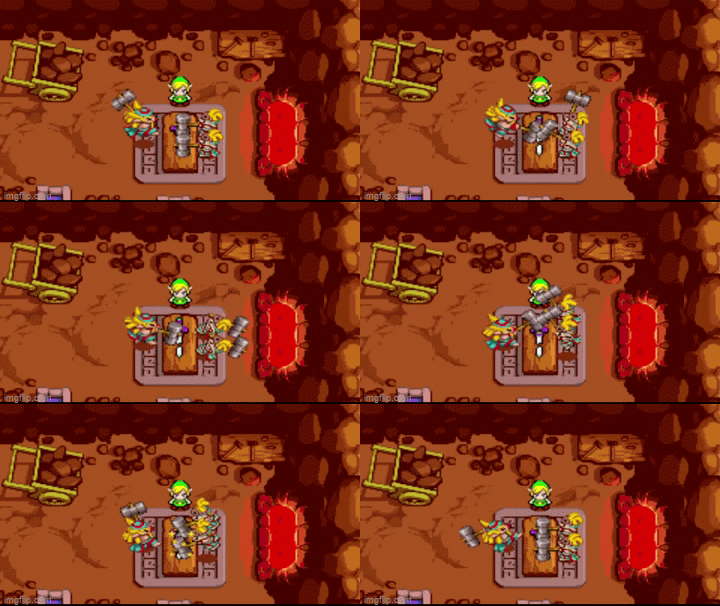
Everyone must fulfill their duties to operate the mine at optimal capacity. Perhaps Melari would never have been able to reforge the Picori Blade without the talent of the third-best of the Minish metalsmiths. Despite never giving his name, he will forever retain an important role in Hyrulean history. His name may be unsung, but his deeds will forever ring in the “Ting Tong” song of the Mountain Minish.