While never the focus of The Legend of Zelda series, magic often plays an important role whenever it shows up. Sometimes magic is just another tool for Link to use, like with the Magic Armor in The Wind Waker. Other times, magical items are plot devices that play vital roles in the story of their game. For example, Ocarina of Time‘s Spiritual Stones or A Link to the Past’s Pendants. No matter how small or large the role, magic is a cornerstone of adventures in Hyrule, and that is no different in Breath of the Wild.
Even though magic appears to be mostly absent from Breath of the Wild at first glance, it plays a deep and compelling role throughout the story that is consistent with magic throughout the series. It parallels Link and Zelda’s character arcs, and it may hint at what is yet to come in the Breath of the Wild Sequel.
A brief history of magic in The Legend of Zelda
The symbols of the Golden Goddesses
Magic has been a staple of The Legend of Zelda series, dating all the way back to the original title in 1986. Since then, however, magic has continued to evolve and change in many ways. A Link to the Past introduced a system of items that drain a magic meter, but this only lasted for a few games. After that, Twilight Princess, Skyward Sword, and the DS titles ditched the magic meter altogether, and let you use magical items freely. Then A Link Between Worlds had a constant item meter throughout. Despite how historically inconsistent magic has functioned in The Legend of Zelda, some things have remained constant, such as the symbolism and powers of magic and its close connections to the Golden Goddesses.
To start us off, magical items bear names inspired by the Golden Goddesses: Farore, Nayru, and Din. Farore’s Wind, Nayru’s Love, and Din’s Fire from Ocarina of Time, along with the three Goddess Pearls from The Wind Waker, are probably the most famous examples. Oracle of Ages and Oracle of Seasons feature the oracles named Din, Nayru, and Farore, who are of course magic users.
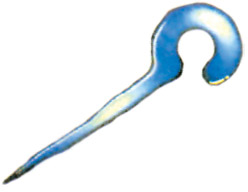
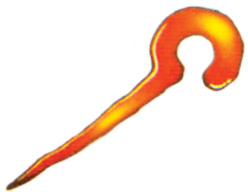
Even if the magical item or person is not directly named after a goddess, it usually shares the colors of the goddesses. You can see this in items such as The Wind Waker’s Deku Leaf, which is the green of Farore, or A Link to The Past‘s Cane of Byrna, and Somaria, which are the blue of Nayru and red of Din respectively. Even the potions of The Legend of Zelda always appear in green, blue, and red.
The Deku Leaf
The Cane of Byrna
The Cane of Somaria
It is also interesting to note that the powers of a magical item often correlate with the powers of the goddesses. Green magic always involves a force of nature like wind or lighting, close to Farore’s powers that brought life to the world. Blue magic always involves protection or ice, correlating with Nayru’s wisdom or the water imagery used to describe her in Ocarina of Time. Finally, red magic almost always involves fire, which is the power of Din. Admittedly, some of these connections, such as Nayru and ice, are a bit of a stretch. However, it is still fascinating that magic of the same colors has consistently held the same powers since A Link to the Past.
Throughout the 35 years of The Legend of Zelda, and especially since A Link to the Past, it has been extremely clear that magic has been consistent in its colors, the power related to said color, and that magic is connected to the Goddesses of Hyrule.
Magic in Breath of the Wild
Now that the pattern has been set for how magic has been presented in the previous Zelda games, let’s take a look at how the series adapted this formula in the convention-changing Breath of the Wild.
Elemental Magic
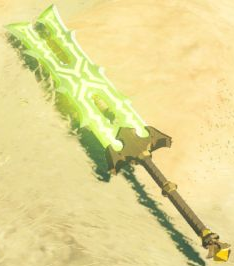
First, Breath of the Wild features a new type of elemental magic. This new magic form is found within different weapons and arrows throughout the game and comes in three varieties. Green lightning magic is found primarily in the Faron region and is used to electrocute enemies. The blue ice magic is used found in snowy regions and freezes everything. Finally, red fire magic is found on Death Mountain and indulges the Hero of the Wild’s pyromaniac side. Each of these three elements also has a respective dragon that contains their power. The three dragons are named Farosh, Naydra, and Dinraal, names that all closely resemble the Goddesses of Hyrule.
Great Thunderblade
Great Frostblade
Great Flameblade
It almost goes without saying that this first type of magic in Breath of the Wild most definitely continues the trend seen in past Zelda games of the green nature, blue ice, and red fire magic. Notably, the blue elemental magic only creates ice. The biggest difference with this new elemental magic system is that is purely natural. Typically, magical items in Zelda have been given by figures such as Great Fairies, the Great Deku Tree, or other of Hyrule’s more mythical inhabitants. But Breath of the Wild‘s elemental magic is almost always found in the wild, besides the occasional item in a Sheikah Shrine.
Sheikah Tech
Second, magic in Breath of the Wild might come in a more artificial form. The blue Sheikah Tech is the main focus of Breath of the Wild, but it also shares many similarities and differences with magic. Therefore, it is debatable whether this is truly magic or not, but for this article, let’s examine the many different ways that it is similar to the supernatural.
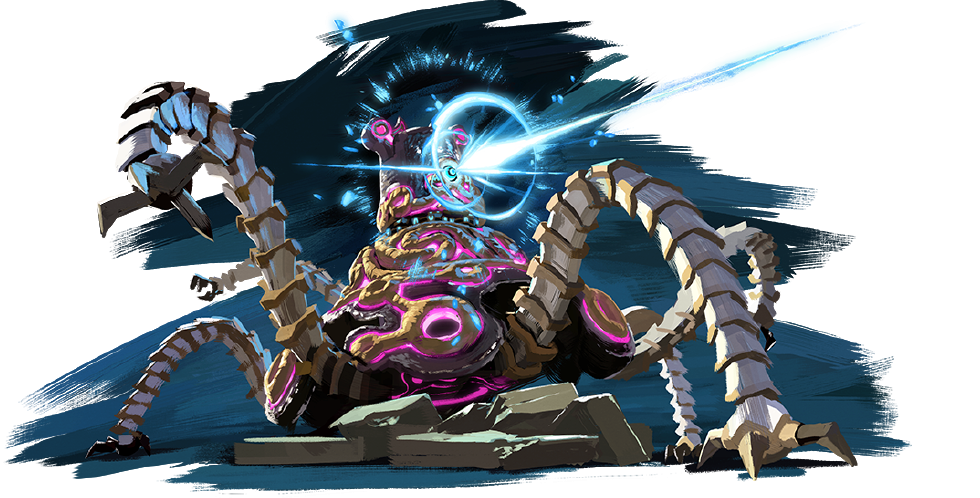
A Guardian powered by Sheikah Technology.
The Sheikah Tech seen within Breath of the Wild takes the form of a blue, liquid-like substance that acts as a power source for various contraptions. These include Sheikah Towers, Guardians, Shrines, ancient weapons, and more. Each one of these machines is meant to contain knowledge or protect Hyrule from its enemies. However, this is not always the case, as an outside source is easily capable of corrupting them.
There is one large difference between conventional magic and Sheikah Tech: The machines often contain vast knowledge or complex A.I. systems that have more functionality and versatility than any magical item. A seemingly simple item like the Sheikah Slate can act as a map, photo album, bomb maker, time pauser, and more. Meanwhile, most magic items only contain one simple power, such as creating flames.
Another difference between tech and magic is the lack of limitations. There are no magic meters or three-hit systems of elemental magic. Sheikah swords, bows, or arrows act as natural weapons, except with the addition of a blue laser. The exception to this rule is the Sheikah Slate Runes, which all require a short recharge rate.
The Sheikah Slate
Symbolically, the Sheikah Tech actually lines up extremely well with the rest of the magic in the series. The first color-coordination box is easily checked off by the blue color associated with the tech. Box two is as easily squared off as the Shiekah Tech is primarily intended to be used for protection and knowledge, aligning both with the traditional blue magics’ power and Nayru’s wisdom.
The origins of Sheikah Tech have been shrouded in as much mystery as the Sheikah Tribe itself, but it could potentially be a form of refined magic, given the color and powers that align with Nayru’s magic. Though, this is mostly speculation and should be taken as such.
How the symbolism of magic ties into Breath of the Wild’s story
While magic and technology in Breath of the Wild have large symbolic ties to the rest of the series, it also plays its own symbolic role within the game itself.
One of the main points of Breath of the Wild‘s story is how it is important to be yourself, despite what others may try to impose upon you, and only then will you become who you are supposed to be. Both Zelda and Link initially fail at the destinies that have been forced upon them, as each is too focused on what others want them to be. Zelda loves to research science and the Sheikah Tech, but the iron fist of her father keeps her traveling across Hyrule to awaken her sealing powers instead. Link changes his whole personality to be silent and stoic in an attempt to meet the expectations of the royal family and the people of Hyrule.
Both characters fail, as Zelda cannot awaken her powers in time to prevent Ganon’s resurrection and Link is unable to defend Zelda. Under the tight control of expectations, the two could never fulfill their destinies. They first needed to be free to explore the wilds of Hyrule.
Oddly enough, the magic in the game follows a very similar suit between the natural elemental magic and the artificial magic-like Shiekah Tech. The natural, elemental magic flourishes across Hyrule and its many regions. But the Sheikah Tech, which was largely being controlled by the Royal Family, fails and turns against the Hylians and seals the kingdom’s fate. The wild and natural magic was thriving, but the attempt to replicate magic completely fails. This once again proves that, according to Breath of the Wild, things truly flourish when they are allowed to be themselves.
Conclusion and impact on The Breath of the Wild Sequel
Magic has had a constant presence throughout the entire Legend of Zelda series and more so now than ever in Breath of the Wild. It has consistently been tied to Farore, Nayru, and Din through its naming conventions and color schemes, and this system remains intact thanks to Breath of the Wild‘s three different types of elemental magic. On top of this, the balance between natural and artificial magic plays into and enhances the story of Breath of the Wild itself, showing the importance of being able to grow on one’s own.
As the Breath of the Wild sequel quickly approaches, this topic could not be more important thanks to the trailers featuring new elemental weapons and a green power that may also be a form of magic. Could this green magic be directly from Farore? Or is it just another “imitation” or refinement similar to the Sheikah Tech? At this point, it is hard to tell, but it is fun to theorize. Magic continues to play a massive role in The Legend of Zelda, making it one of the most important topics in the series that can lead to many exciting possibilities.
Reina Proctor
Reina is life long Zelda fan who recently graduated college with a degree in Global Studies and the Japanese language. Her favorite Zelda games are Breath of the Wild and The Wind Waker. Besides Zelda, Reina is a massive fan of the Metroid franchise and is a coach of collegiate Splatoon.


 by Reina Proctor on October 25, 2021