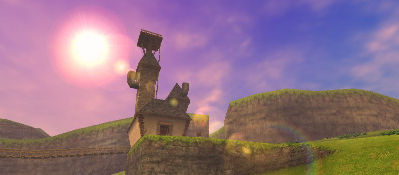
There’s something special about the Lakeside Laboratory in Ocarina of Time. It’s just got that “it” factor that makes it particularly memorable to us gamers. As I previously explored the Hateno Ancient Tech Lab and Akkala Ancient Tech Lab from Breath of the Wild, here I’m going to look at our very first Legend of Zelda Lab and explore what makes it a true classic.
Coming up to Lake Hylia as Child Link, at first, all you can see are two narrow towers in the near distance. Cross the short incline that blocks the building from view and you’ll see the Lakeside Laboratory in all its quirky glory.
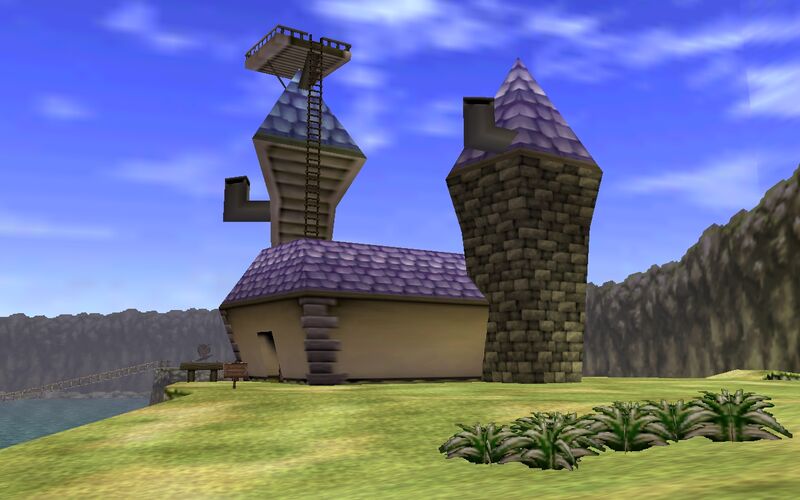
This building looks unlike any other that you’ve seen in this Hyrule. Hyrule Castle Town is conventional, the Temple of Time grand in an understated way, and even the Kokiri Forest homes are simplistic and a tad rustic. But the Lakeside Laboratory blows them all out of the water (sorry), especially in terms of classic Zelda oddness.
The building comprises a squat, whitewashed main building, with a narrow base that widens to the point of the roof tiles. The roof itself slopes inwards, mirroring the base of the building and providing a flat roof that can be accessed, which I’ll come back to later.
Jutting out from the roof, which has excellent bright purple tiles, are the two towers we first spotted. These have peaked roofs, wonky-looking chimneys, and the taller of the two has a large platform balanced at its apex. A ladder extends from the flat roof to the taller platform, and when you circle around the building, you can see that this tower has a funny triangular structure, while the other is more square.
To me, this building screams “mad scientist.” Irregular architecture, cobbled together, perched right on the side of a massive lake — well, who else could live there? It’s hardly a place for a regular home. Inside, it doesn’t disappoint.

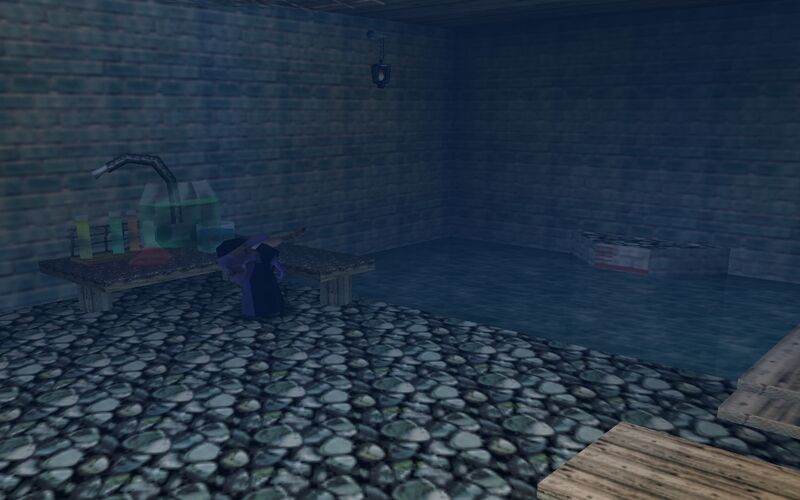
The interior is pretty stark, especially in contrast to the Hateno Ancient Tech Lab, but don’t mistake this for a lack of detail. While the color palette inside seems pretty flat, look closer and you’ll see many contrasting textures and materials in this room.
The floor is a dark flagstone, almost rough-hewn, and looks very naturalistic. The stones here haven’t been manipulated beyond their basic placement. This contrasts nicely with the pale gray bricks that make up the walls. These are smooth and uniform, both in size and color, though there is a slight gradient that is far less noticeable than that of the floor. The walls look neat and orderly, the floor fairly natural and chaotic.
There are only really four pieces of furniture in the room, and they match this aesthetic perfectly, blending in to the room as a whole. From the left of the door, there’s a large tank with a beveled glass top and a smaller stone base. The base looks like a drystone wall, more ordered than the floor but not baked bricks like the walls. In the tank is an octopus-like creature that looks slightly menacing. You might think it was pickled if it weren’t for the bubbles moving in the tank.
Beyond the tank is the workbench, covered in vials and beakers filled with bright-colored liquids. There’s a hose or pipe extending from the largest container, and what looks a little like Zora Eggs in a small pot. The workbench is crafted from bleached wood and covered in some kind of speckled brown fabric. Look closely and you can see the nails stretched over the surface of the table.
Of course, the Lake Scientist himself is also a sight to behold. Bent and wizened, with huge protruding teeth and bunches of white hair escaping from his cap, he looks the part of a mad scientist. He nods and sways, suggesting extreme age even more so than his appearance.

On the other side of the floor are a small table and a single stool of the same bleached wood. Above it is a lone lamp suspended from the ceiling, and on the wall next to it are several spears and what looks like a very large bonesaw. Behind this is a wide display unit, the base made of the same brick as the walls but the shelves of the light wood. Could it be reclaimed driftwood?
On the display shelves are some large shells, giving a splash of muted color to the room. The reason I emphasize the color scheme in this room is simple: When you combine all these elements and look at them as a whole, the setting looks like the Hylian interpretation of somewhere clinical. Here, there are no stainless steel or white lab coats, but the pale colorings read like a real-life laboratory and give this place that “sciencey” feeling. In some ways, it’s what they didn’t add to this room that makes it seem clinical. It is fairly bare and minimalist, a pure and clean workspace.
If it seems I’ve missed something important, it’s because I have saved the best until (almost) last. Stretching the full width of the room, and taking up just under half of the floor space, is the diving tank.

I’m not sure what the actual scientific purpose of the tank is (I’m not a Hylian scientist, after all) but as the old man will tell you, he’s trying to make magic potions out of the lake water, so I’m sure having a large volume of it is useful somehow. There’s a narrow platform on the right-hand side made of a darker wood, and a little stone ledge in the middle of the back wall that reaches all the way to the bottom, depth indicators marked across it all the way to the floor.
At the bottom of the tank are some rupees that you can pick up if you’re smart about it, and a breakable crate. But the real wonder of this lab is lurking in a large hole in the wall. That’s right, of all the weird additions to any Zelda game, there’s a massive shark in the tank.

The mysteries of this legendary shark have been explored in a previous Zelda’s Study, but suffice to say, this really throws you off when you first see it. Nothing else in these games seems quite so incongruent. Enemies and bosses borrow from real-world animal species, and yes, there are horses and cows, but they are only ever in farms. Even the chickens are given a Zelda makeover! But here, in the Lakeside Laboratory, is a shark. Sharks don’t even live in lakes!
Beyond the shark revelation, there is little more to explore inside the laboratory, but going back outside, there’s a curious patch of soil. You can plant a Magic Bean, travel to the Temple of Time, and return to the lab as Adult Link to access the roof. The first part of the rooftop has little to explore, though there are rungs on it that look to be a non-slip aid. They may have been put there by the Lake Scientist in his more agile days to make rooftop access safer. How he got up there is unclear, as there is no ladder to this first portion of the roof. There is, however, a ladder leading up to the platform balanced on the roof of the taller tower. Up here is one of two Pieces of Heart that you can find in the laboratory.
From here, you can also get a clear view of all of Lake Hylia. It’s a great place to watch the sun rise and set. Take a pause here and you won’t regret it. There’s not much else to look at up on the roof, but part of the joys of any Zelda game is finding access to a seemingly inaccessible building, rooftops particularly, and just having a look around. Like so many moments in these games, it’s the problem solving that pays off, and the feeling of satisfaction when you’ve climbed to the top.
And, as always, finding a picturesque view in Hyrule is worth the toil, because it really is beautiful.