I loved Link’s Awakening back on the Game Boy. It’s consistently been one of my favorite Zelda games. Even though it’s original game was hardly a graphical marvel, having only two-bit, black-on-green graphics and only a 160×144-pixel display, it was the first Zelda title to pull deep lore and evocative story out of the games’ then thick instruction manuals into the gameplay and the in-game text.
Grezzo’s Link’s Awakening for Nintendo Switch is a very, very faithful adaptation of the Game Boy original. Or, more strictly speaking, it is a very, very faithful adaptation of the 1998 re-release of the colorized DX version of the game. Whether you’re a veteran of the game coming for some nostalgia or a newcomer to Link’s island journey eager for another adventurous romp, I personally think you’ll find 2019’s Link’s Awakening a worthwhile journey.
Full disclosure
Nintendo Australia graciously gave Zelda Universe a review code for Link’s Awakening.
Marooned in a colorful, vibrant paradise
Koholint Island’s colors are rich and vibrant. Even its own desert has a rich sense of beauty.
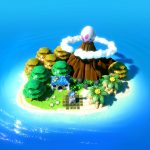
Thanks to the absence of in-game manuals, some amount of the backstory for Link’s Awakening now remains completely unsaid and is left to the imagination. But in brief, Link is off on the high seas, sailing off in search of a new adventure when a storm suddenly pelts down and catastrophe strikes. His ship is struck by lightning, and our hero is tossed into the violent sea, only to wash upon the shores of a beautiful tropical island with one curious geographic feature: Its tallest mountain delicately holds a giant egg upon its peak. The townsfolk living on this isle are nice, though clueless of the outside world. But lo, suddenly a curious Owl approaches, and he spins the tale that trouble brews deep within the island. And with that brief introduction, the otherwise plucky Link realizes that he has found the adventure he was looking for.
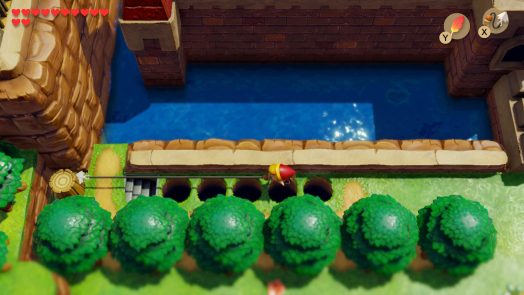
Visually, Link’s Awakening has a very distinct feel from Grezzo’s other Zelda entrants Tri Force Heroes and the 3D versions of Ocarina of Time and Majora’s Mask. This unique visual style gives Link’s Awakening a renewed sense of charm and beauty. I’ve heard that some aren’t fans of the art style of the characters, but I for one welcome this new style. Much of the game is rendered with a style that evokes looking at miniatures or tiny dolls. While in the overworld, the camera renders everything with a tilt-shift effect — blurring the extreme foreground and background — to enhance the effect of looking at an elaborate diorama. The characters and enemies, once blocky sprites with only a few frames of animation, now leave nothing to the imagination of what they represent. While many of the game’s friendly characters don’t really have much screen time or personality (remember this was originally made in 1993), they have been rendered and animated beautifully in exaggerated and dramatic ways to really give these minor characters the personality they deserve. Overall the colors of the game are bright, vivid, and memorable, just like how you’d expect a lazy, tropical island to be.
The characters have personal quirks that make them memorable. Richard’s cape toss and sparkles, however, take the cake.
Though the Switch is technically capable of churning out graphics up to 1080p as far as resolutions go, Link’s Awakening only renders at 720p. This is quite the surprise considering that this game renders fewer pixels per frame that Breath of the Wild did (which weighed in at a 900p display). Furthermore, the game does struggle to keep up with 30 frames per second. While I don’t have any scientific numbers to say how badly it can chug, the framerate hitches seem to almost be caused by nothing at all. Certainly, drag eight Moblins on the screen, each of them throwing spears at you, and the lag is obvious; however, sometimes the game will drop a few frames for no apparent reason whatsoever. A few dropped frames here and there doesn’t faze me that much because I rarely notice it, but this could be a distraction for those who pick up on unsteady framerates.
Each house has its own unique décor, thus providing the residents with their own personal flair.
Visual techo-babble aside, for those who do remember playing either the Game Boy or Game Boy Color versions of Link’s Awakening, the Switch rendition does so much to artfully depict the world of Koholint. This may sound like an unimportant detail, but every individual house in the game is uniquely decorated with its own objects and style. You won’t find any copying and pasting of assets here; there is an attention to detail and a purposeful attempt to dress this game up in its finest graphics that is hard to comprehend. Everywhere in the world, your eyes will marvel at how Koholint’s various destinations stand out from all the others. It’s a rare visual treat to see in a video game.
The other big change graphically from the Game Boy versions is that the overworld is no longer locked into focusing on strict terrain tiles, only scrolling to reveal the next one over when you reach the edge of the screen. For the Switch version, the camera locks Link into the center of the screen at all times. This means that when you run up to an obstacle you cannot tackle yet, you can look over that tree line to get a preview of what’s on the other side. On the flip side of the coin, you can’t just escape enemies by transitioning one screen over; enemies will happily pursue you (at least to a degree) across longer distances, meaning that you ought to be a bit more careful when prancing about through dangerous turf. The combat ultimately isn’t as tricky as Breath of the Wild’s where you must be extremely careful; there’s plenty of hearts that drop from bushes and enemies to heal yourself with. Then again, the obligatory Hero Mode changes all that, but more on that later.
The music of koholint has been beautifully remastered, and the melodies now feel like musical masterpieces.
The sounds of the game are utterly amazing as well. The music of Koholint has been beautifully remastered, and the melodies of yore now feel like musical masterpieces without the limitations of the bleeps and bloops of early ‘90s hardware. While the music in each area hasn’t changed — the melodies in each area are identical to what they were — the music now feels like it really characterizes each area, imbuing it with a unique vibe. The sound effects also are cute and charming as well, adding a not-quite comic level of fun to the ambiance. Whenever Link starts up to dash, the cartoonish pitter-patter of his feet accelerating in place right before he takes off delights me to no end.
A Nightmare on elm island
The most commonly used items get their own dedicated button. You’ll spend less time digging around in the items menu.
But visuals and music are nothing without gameplay, and the gameplay has received just as big a facelift as the graphics has been given in this remastering of the game. In the original game, the controls were somewhat hampered by the fact that you only had so many buttons on the console. Beyond the D-pad for movement, the Select button for the map, and the Start button for the items menu, there were only two other buttons for Link’s entire arsenal, meaning that Nintendo couldn’t even afford to have a single button dedicated to the sword since there were times Link needed to use two of his items simultaneously to solve puzzles and advance.
In the Switch release, this has all been solved thanks to the Switch having several other buttons to offload the more commonly used items. Not only do the sword and shield now have separate buttons each, but now the Power Bracelet (used for lifting rocks and pottery) and the Pegasus Boots (used for dashing about the island) have been given permanent buttons as well. And while it would have been nice to have one more slot for a random item, having two buttons for the remaining nine items (not including bottles) is enough to significantly reduce the amount of time you’ll be in a menu doing inventory management.
Link’s Awakening has also modernized movement across the world as well. In the original, there were four warp points in the world that provided fast travel between each of them. However, to warp between these locations, you would have to physically be at one of them to make the warp. Grezzo has decided that it well past time to bring in a fast transportation network on Koholint. First, there are more warp locations this time around with the number rising to 10 fast travel points. Furthermore, fortuitous adventurers may find an item in the game that will allow you to warp to any of those markers from anywhere in Koholint, not just from those warp points. All of this results in speeding up the game considerably. On the plus side, it’s good in that you’re no longer traversing well-trodden pathways over and over again. On the flip side, Koholint already isn’t that massive of an island, and this just makes that world feel considerably smaller. All in all, I think I’d go a bit crazy if I had to go back to the DX version sans prevalent fast travel.
The Switch version makes it even easier and faster to get around the island, but it almost makes the island feel too small.
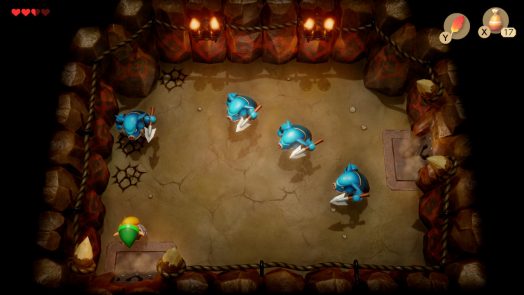
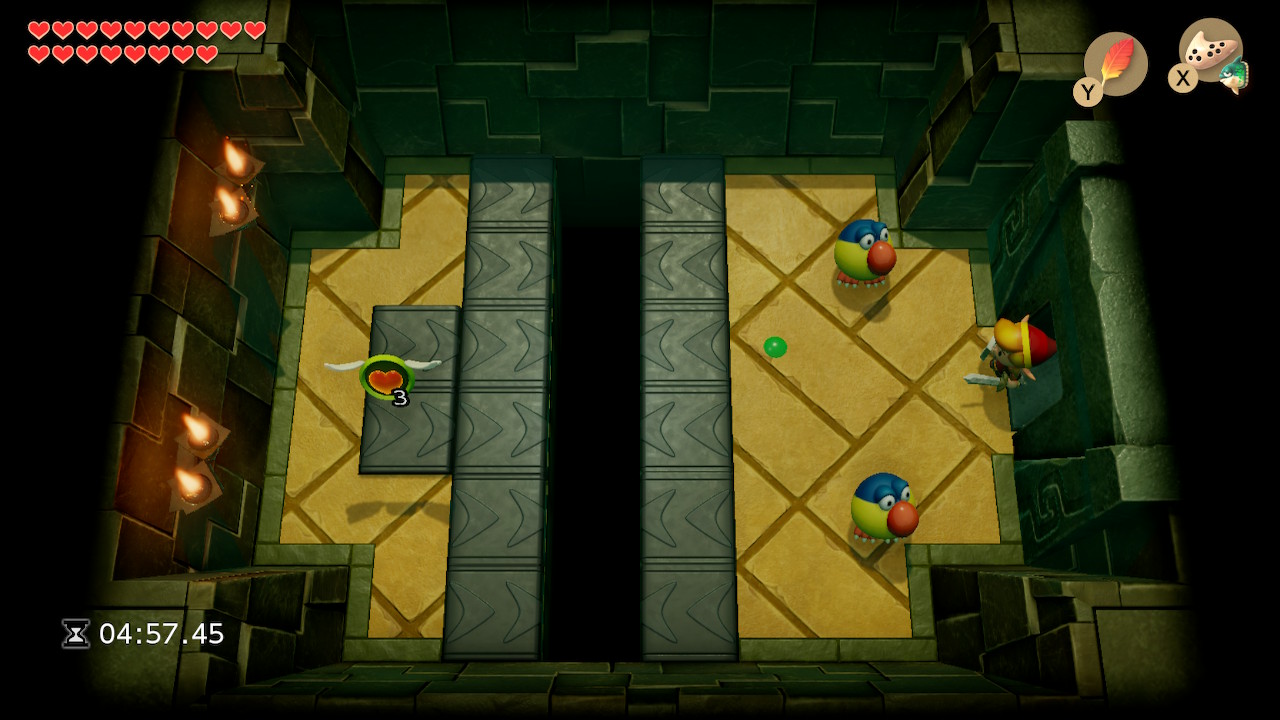
Someone forgot to tell these Moblins that Link’s Awakening is supposed to be a 2D Zelda game.
Another thing that is significantly different is that Link’s Awakening for Switch — though still technically a “2D Zelda” thanks to its overhead graphics — is now very much a 3D game in terms of combat. Neither you nor your enemies are limited any longer by only attacking horizontally and vertically; now spears can fly at you from the 45° angles or anything in between. I never used to use the shield that much in the original game because dodging thrown items was extremely easy. (Plus, it was way more fun to hop like a madman everywhere with Roc’s Feather.) However, that is no longer the case. That shield is an absolutely necessary part of your inventory, and you’ll be using it very often. At first, I found using the analog stick quite awkward as my mind always wanted to revert to strict 2D mechanics. However, as I played the game, I found I finally adapted around the game’s midpoint.
On a difficulty scale, with few exceptions, Link’s Awakening rates on the easier side of the Zelda spectrum, and the Switch release does a few things to make it even easier. Grezzo has added a trio of bottles to Link’s inventory this time around, and each can hold a fairy that will heal you when it’s let go. This is on top of Crazy Tracy’s secret medicine which, if found or purchased, will completely refill your hearts once you’ve lost them all. The fairies, unlike every other Zelda game, will not free themselves if you die; you must physically uncork the bottles to let them go, making them more like potions. You can also get more hearts in the game as the maximum heart gauge has risen from 14 to 20.
The Switch variant gives you plenty of hearts, making this a more forgiving Zelda game.
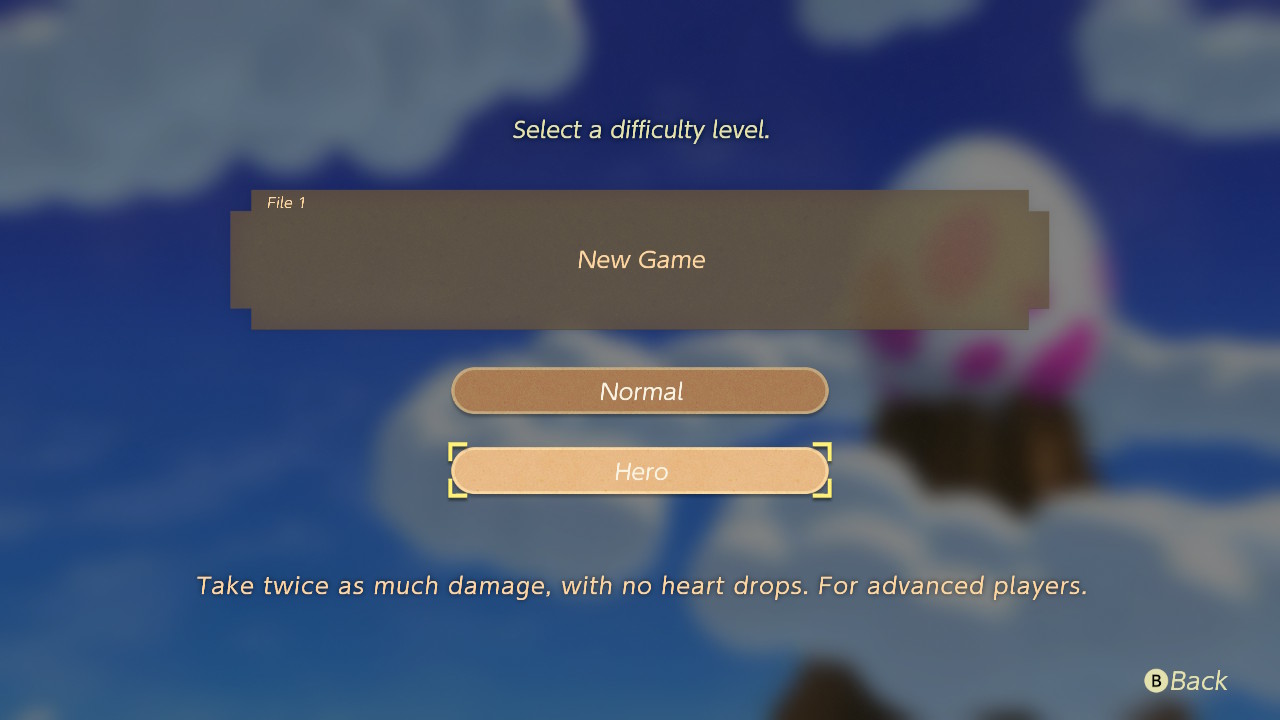
However, true heroes can choose the more difficult mode straight from the title screen.
But some adventurers laugh in the face of danger. Some might eschew the very thought of needing every third enemy or every fifth mowed bush giving you a life-giving heart. Some people don’t always take damage, but, when they do, they prefer to take double damage. That means Hero Mode is for you. I personally haven’t played Hero Mode ever in any Zelda game; if Hero Mode were about removing the heart drops or doing double damage, but not both, I’d have signed up long ago. But if you like to have a challenge, Hero Mode is unlocked starting the moment you boot up the game for the first time.
Making your foes rest in peace
While combat in general has been significantly improved, the game’s dungeons have had far fewer updates given to them. The developers seem to have taken the prerogative that the dungeons themselves were nearly perfect in their original (or rather, their DX) state and haven’t made many (if any) changes to the dungeon layouts, enemy placement, or chests. So if you’ve played Link’s Awakening at all recently to prepare for this game, you’ll likely find the dungeons not much of a surprise. (I mean, there will be one or two minor surprises to be found, but even those surprises aren’t revolutionary in the least.)
The dungeons are prettier, but they haven’t changed much from Link’s Awakening DX.
But subtle touches as only having to solve each puzzle once is a nice, modern bonus.
That being said, there are a few subtle but much appreciated mechanics that did get changed in this outing. In many older Zelda games, doors that would seal shut until enemies were defeated, a torch that was lit, or a button that was pressed would inevitably reset if you left the room and came back later on. This meant that any requisite backtracking you’d need to do would have you solving that puzzle repeatedly throughout a single dungeon delve. However, this is no longer the case. Once you solve a room and open the doors to the next room, those doors will remain permanently open. Even if the enemies respawn later, you won’t ever need to defeat those nasty monsters again just to head west to the next room. Similarly, some of the game’s mini-bosses who get reused in later dungeons will eventually reprise their roles as “normal” enemies. In the original game, those mini-bosses would invariably respawn after you wandered too far away. But now these “mini-bosses” won’t ever respawn; once dead, always dead.
One of the other critiques of the original game was that some of the dungeon bosses were a bit, well, uninspired, to use a kinder phrase. Either the bosses were just weird (Zelda developers and their love of eyeballs is well-documented) or didn’t have very exciting mechanics (case in point: The fourth boss of the original could literally be killed before it even attacked once). While Grezzo wouldn’t dare go so far as to change the bosses of the dungeons, they did update some of the bosses’ mechanics so that they feel like fun fights. That fourth boss takes significantly more hits to kill this time around, and it starts attacking straight out of the gate. These additional boss mechanics are generally not earth-shattering by any means, but it does make beating each dungeon feel more like an achievement.
I almost didn’t need to see what Moldorm looked like in HD.
Gotta collect ’em all!
The Trendy Game returns and is more robust than ever. Annoyingly so since prizes can fall out of the crane after being snatched.
The last portion of the game to receive a major upgrade is the mini-games and the collection sidequests. In Link’s Awakening DX, there were three major mini-games on offer — the Trendy Game (think those crane games you find at the mall), fishing, and the Rapids Ride. (And let’s be honest, the fishing mini-game wasn’t so much a game as an activity you played once to get your Piece of Heart and never went back to.)
In the Switch rendition, these have all been fleshed out and expanded, not to mention that a fourth game has been added to the mix. The Trendy Game now uses some very vague attempt at “real physics.” It’s not actually real physics, but there is an amount of hand-waving to make it feel somewhat accurate. In the original game, you pretty much played this game once at the start to get the Yoshi Doll and then never again. Now, the Trendy Game periodically adds additional figurines to the prize pool to keep you coming back to play. The fishing mini-game has the most drastic improvements as now you can fish your heart out with catching multiple types of fish that keep respawning repeatedly. Each class of fish has a unique mechanic that requires you to reel it in with different timings so that your quarry doesn’t get away. And finally, the Rapids Ride now has a second mode that challenges you to race to the bottom at top speed instead of just collecting the random items hovering above the water. All in all, these are nice additions to flesh out the game and add a bit more depth.
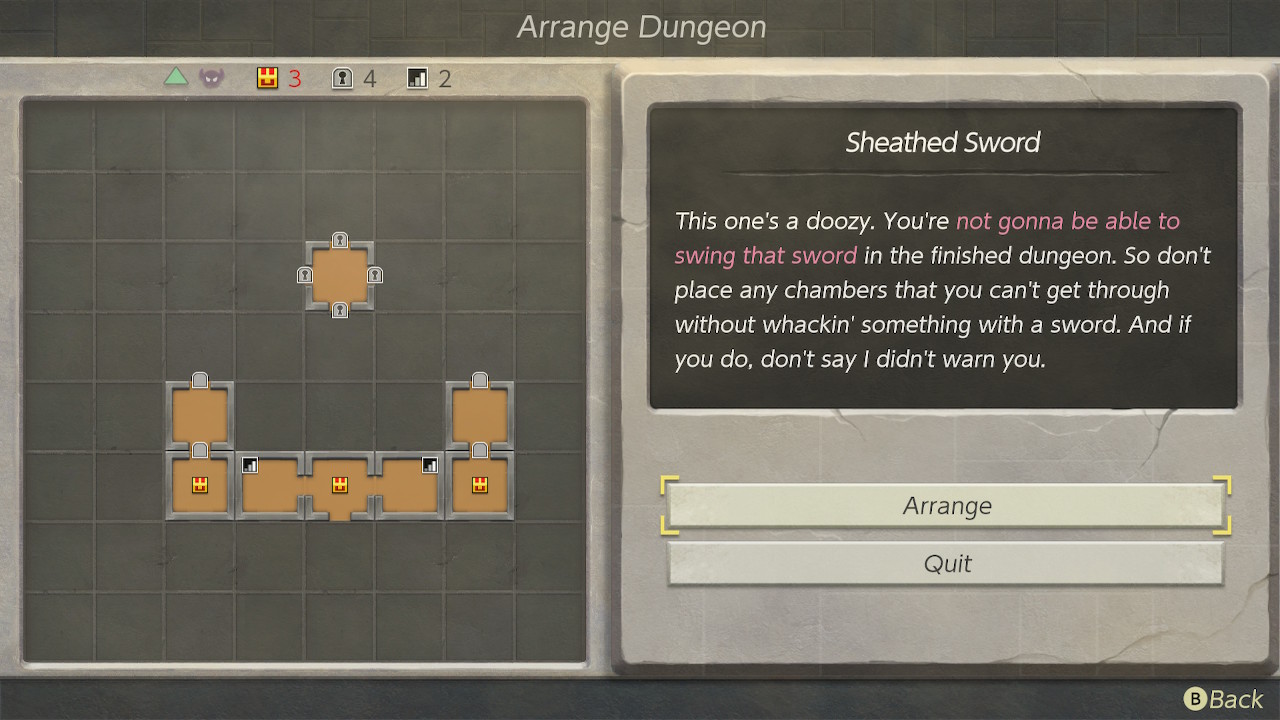
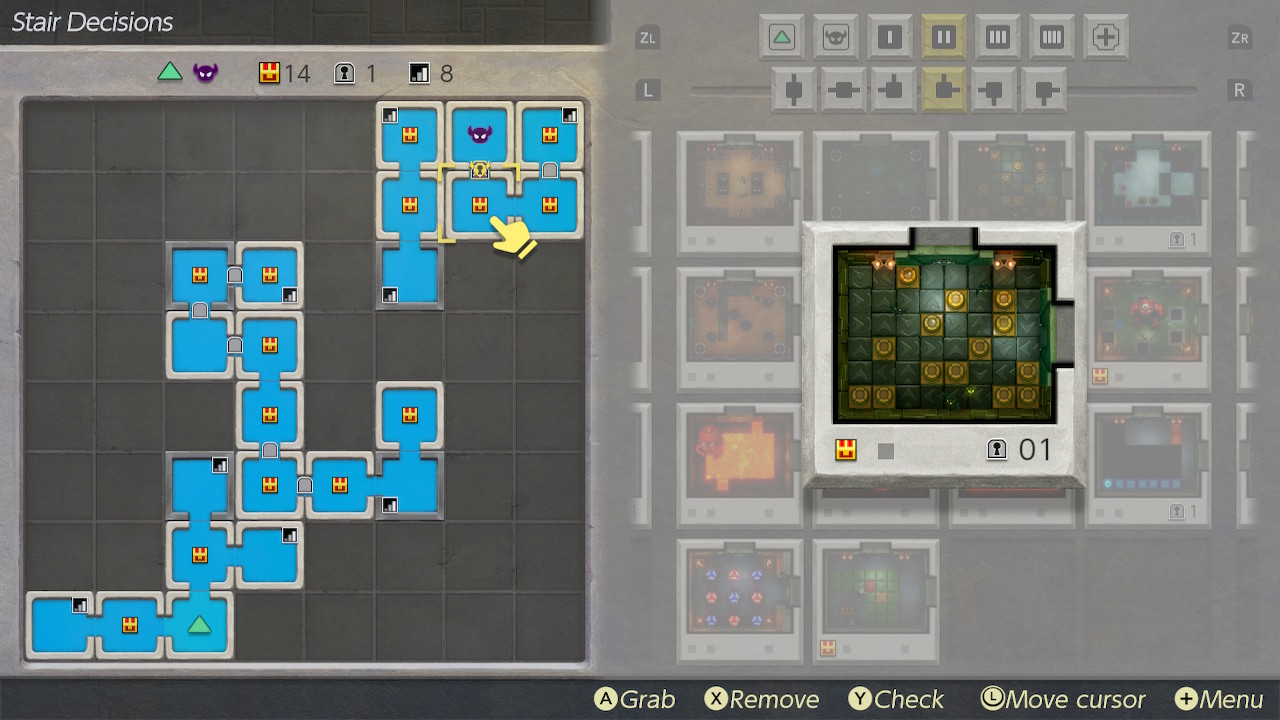
With all these positive additions, it’s unfortunate that the new mini-game Dampé’s Chamber Dungeons is the one that fails to impress. The gravekeeper Dampé has moved to the isle of Koholint, and he’s willing to construct brand new dungeons for you comprised of individual rooms cobbled together from the game’s canonical dungeons. In each challenge, you’ll need to lay out a set of rooms that make an otherwise valid dungeon (e.g., there’s always an entrance, a boss chamber, sufficient treasure chests for small keys before a locked door, and a valid path to every dungeon tile). There’s usually several special conditions that have to be met, ranging from the minor restriction of forcing certain dungeon squares to have a treasure chest to more exotic restrictions such as three-heart or sword-less challenges.
On paper, it sounds like a great idea. Infinite dungeons! Who couldn’t love that? It actually sounds like Nintendo and Grezzo are dipping their toes into the pool of either a potential The Legend of Zelda randomizer game, or maybe a Zelda Dungeon Maker akin to Super Mario Maker. And were it that, I’d be excited.
Most of Dampé’s challenges are fairly boring, but every so often there’s a tricky one.
At first, dungeon design seems quite fun as you try to create a working dungeon.
Since all of Dampé’s rooms come from dungeons, the Chamber Dungeons don’t really stand out.
Unfortunately, it’s not. The first major flaw is in the sharing of dungeons. While it’s true that dungeons can be shared, they can only be transferred to another person via the storage inside an amiibo. There’s no online functionality whatsoever, so, if I want a friend to play my creation, I have to either meet him or her in person or send my amiibo via the unreliable postal service. No thanks! So I doubt I’ll ever really build a Chamber Dungeon for anyone other than myself. The second major flaw is that none of the dungeons you end up building have any sense of real character, theme, or originality. Every tile available to you is ostensibly a dungeon square ripped out of context from another dungeon, meaning you’ve already played it before. Furthermore, since you’re invariably the person who made the dungeon, you already know the dungeon’s layout. This allows you to potentially shortcut and circumvent your own traps since nothing should be a pleasant surprise. I personally find myself reusing the same tiles repeatedly because they’re the easy ones to go through. I suppose this does let you create something of your own Boss Rush mode where you can face all the dungeon bosses back to back, but I’m less excited by this premise than others might be.
Since you’re the person who made the dungeon, you already know everything. Nothing in the dungeon will be a surprise.
As far as the game’s collectibles go, they’ve been expanded upon greatly as well. The original game only had 12 Pieces of Heart and 26 Secret Seashells, of which you only needed 20 in order to unlock the game’s best weapon. Grezzo decided these numbers were too paltry and started sprinkling more of these objects everywhere. Link’s Awakening for Switch now has 32 Pieces of Heart and 50 Secret Seashells to be found. Having played the original multiple times, I appreciate both the fact that all the original Pieces of Heart and Seashells are where they originally were, as well as the fact that there are new ones to find, keeping the game fresh and the discovery constant.
Oh goodie, yet another dungeon tile for the mini-game I’m avoiding playing.
The sticking point with nearly all of the mini-games and the collection quests is that, oftentimes, the reward for completing them doesn’t feel worth the effort. There aren’t any sort of new upgrades to your inventory, no awesomely cool, shiny versions of weapons. There isn’t even any acknowledgement in your game file that you beat all the things or collected all the secret doodads lying about. In fact, most of the mini-games and collectibles try to push you deeper into the Chamber Dungeons, which we’ve already discussed as not being my favorite part of the new game. I suppose that completionism is still its own reward, so personal satisfaction and a pretend Platinum Trophy is good enough for me.
A classic tale for the ages for the modern day
Link’s Awakening is incredibly charming, and I’ve always felt that it was a bit of an underrated game. As far as stories go, Awakening has one of the best in the entire franchise, and it still holds up today. While it is slightly disappointing that there isn’t a bit more depth to the story this time around — nearly all of the dialogue is directly lifted from or heavily inspired by the DX version — or that none of the game’s additions really stuck the landing, it still is a very fun romp. For me, it certainly tickles the nostalgia bone, and I think this will delight many people after they see how lovingly crafted and how graphically and mechanically uplifted this new version is.
The Switch remastering isn’t perfect. Some of new content isn’t really as fun or as rewarding as the rest of the game. Coming up with a way to adequately reward players for completing new bonus content while not breaking the careful mechanics of the original game is certainly a challenge, but it’s one that Link’s Awakening doesn’t handle gracefully. And while Link’s Awakening doesn’t really need 1080p resolution to look good, the frequent graphical hitches that happen as neighboring areas are being loaded in the background are noticeable.
The Switch remastering isn’t perfect. But I honestly feel that this remake is now the definitive version of link’s awakening.
But overall, I do recommend getting Link’s Awakening, especially if you haven’t played the game before. I honestly feel that this Switch remake is now the definitive version of the game. That this will be made available to a new generation of The Legend ofZelda fans is truly exciting.
Score
Similarity to other Zeldas
9/10
Oracle of Ages/Seasons – ▲▲▲▲▲ A Link Between Worlds – ▲▲▲▲△ Ocarina of Time 3D – ▲▲▲△△ Breath of the Wild – ▲▲△△△
David Johnson
David Johnson, a.k.a. "The Missing Link," was once the webmaster of both Zelda: The Grand Adventures and ZeldaBlog. He works as a software engineer in the games industry. David also pontificates about Zelda, writes features and guides for ZU, and obsesses about CD-i.


 by David Johnson on September 19, 2019