PART ONE
A few years ago, while I was replaying The Legend of Zelda: Majora’s Mask, I reached the top of Stone Tower and took another look at the strange scenery there before moving on. The gigantic pointing blood-stained hand again caught my attention. It seemed so strange, so ominous, like there was some cryptic meaning behind it that I just couldn’t place. But this time, something clicked in my mind.
I understood the significance of that pointing hand, the meaning that had always eluded me before. Now I wanted to know why it was there.
What secrets has the game been hiding all this time?
Termina’s Tower of Babel
After investigating the Stone Tower Temple and glancing through several theories posted online, I pieced together my own theory. According to this theory, the Stone Tower is related to the Tower of Babel.
They stood for a moment staring up at the structure, imposing and impossible and threatening.
“What was the story of the Tower of Babel? Does anyone know? It’s a Bible thing, right?” Jobs asked.
Mo’Steel shook his head pityingly. “You are such a heathen, Duck. The people made a tower to reach all the way up to heaven. God didn’t like their attitude, getting above themselves and all. So he turned them against one another by making them speak all different languages. That way they couldn’t cooperate and make any more towers to heaven.”
Jobs made a face. He was on the verge of saying that it was a stupid story. But Mo’Steel would be offended. “An allegory of human pride,” Miss Violet Blake said. “A pretty good allegory if you wish to instruct people in humility.”
—Remnants: Them, K.A. Applegate
An ancient people built Stone Tower as a stairway to the heavens. They would invade the Sacred Realm and slay the Goddesses of the Triforce, using the power of the Giant’s Mask. They would prove once and for all that their four beloved Giants were superior to some female deities.
The Goddesses were not pleased, so they let their divine Light Arrows fall into the hands of these wicked people. When the Light of Justice shone upon the blood-stained emblem of the tower, it rearranged things. The world was reversed so that the earth was positioned in the heavens and the sky was beneath the people’s feet.
The people came across a strange portal in the sky, and when they entered it they were transported into another dimension. But this dimension was not the Sacred Realm they had hoped to find. The universe had been flipped upside-down, and so the stairway to the heavens had become the road to Hell. This dark realm consisted of a vast desert scorched by violent sandstorms. And in this realm there lived an evil being, a monster that had been sealed away after its makers realized the extent of its dark powers.
It was Majora’s Mask. The wicked people delighted in their discovery, and brought it back with them into their world. They built monuments to the mask in both the desert and in the temples of their own world. And so their world became marked by the devil. This cursed land was thus given the name Termina, because it was doomed to end.
Fact or Fan-Fiction?
“Belief or disbelief rests with you.”
—The Garo
So…that theory might sound like a bunch of fan-fiction. Nevertheless, there is content in the game that led me to these conclusions. I’ll review the evidence, explain my reasoning, and let you decide whether or not I might be on to something.
To start with, there’s the entrance to Stone Tower. Sometime before I even began putting together this theory, I noticed that the huge statue at the entrance was a bit obscene. The statue shows a giant naked man sitting with his hands on his knees. His mouth is gaping open and his tongue extends to the ground, covering up the area between his wide-open legs. You enter Stone Tower by walking up his tongue and into his mouth.

Inside the tower, you must manipulate a series of blocks that share a very similar design. The blocks depict the same nude creature as the entrance statue, but here you can see more of the figure. If you look at the blocks from a few different angles, you’ll notice that the bottom side shows the gargoyle’s naked behind. Next to the butt cheeks, right where you might expect to see the creature’s crotch, you instead see the Triforce, the sacred emblem of the Goddesses of Hyrule. The gargoyle is licking the Triforce, which is disrespectfully displayed on the bottom side of the blocks.

And then there is the giant pointing hand mentioned earlier. It points towards the sky, and its finger is ablaze. Right next to the pointing hand is a pillar that happens to be rather phallic. When I was playing the game, trying to figure out why the pointing hand was there, it occurred to me that the builders of the tower were saying something along the lines of “Screw you!” to somebody. The ring of fire on the fingertip indicates anger, and we all can figure out what the phallus implies.


Many people who’ve read this theory quickly dismiss the idea that Nintendo would intentionally place a phallus in a Zelda game. It’s worth pointing out that Banjo-Tooie (another family-friendly N64 game released a month or so after Majora’s Mask) did the same thing though perhaps for less tasteful reasons. And, Nintendo did display butt cheeks on the gargoyle blocks in this Zelda game. I expect that the artists who worked on the game would notice what these pillars could appear to be, especially after designing those obscene statues for the same area. The fact that they prominently displayed that pointing hand next to one of these pillars further indicates that they intended for the pillars to be phallic, and that they wanted older players to notice. Earlier designs of Stone Tower still included the phalluses and pointing hand, indicating that they’re important to the design of Stone Tower, and not just last-minute additions.
 Interesting scenery in Banjo-Tooie
 An early version of Stone Tower
Most likely, plenty of people will still reject the idea that Nintendo would knowingly place this sort of content in a Zelda game. But if those pillars are indeed meant to be phallic, Nintendo included them for tasteful, justified reasons. Their design is abstract enough that younger players will not catch on, and their inclusion adds a great level of depth and darkness to the game’s story and setting. Majora’s Mask is a trippy, out-there sort of game—there’s the man stuck in the toilet, the Moon that comes to life, and the beautiful field you enter before the final battle. Majora’s Mask is not afraid to be shocking and strange, and there always seems to be a great deal of artistic merit to the content in the game. Would this game go so far as to include an abstract structure that’s supposed to look like a phallus to older players? It’s up to you to decide what to believe here.
Going back to the pointing hand, it’s probably not a stretch to say that the “Screw you” message is directed at the Goddesses of the Triforce. The hand points towards the sky, which is often associated with the heavens. The heavens can be associated with the Goddesses and the Sacred Realm in this case, because the image of the Triforce actually appears in Stone Tower; the game’s artists are reminding us of Hyrule’s Goddesses with that symbol.
There is actually more than one phallic pillar in Stone Tower. Four of them surround the giant face that is the entrance to the temple(1). Each phallus represents one of the four male Giants. The design of the temple entrance is also reminiscent of the bearded faces of the Giants, though we never see a Giant open his mouth. But the implied message here seems to be that the builders of Stone Tower love the Giants of Termina and reject the female Goddesses who claim to be superior beings.
The architects might have planned to wage war against the Goddesses once they had invaded their realm. The Giant’s Mask is tucked away inside Stone Tower, and the game does not provide any explicit backstory for the mysterious artifact. But if we accept that the architects loved the Giants and hated the Goddesses, we can assume that they wanted to demonstrate the superiority of the Giants. The Giant’s Mask was their symbolic weapon; it would bestow tremendous power upon them, the power of a Giant, once they had reached the heavens. They hoped to use that power to destroy the Goddesses.
Now, the Goddesses of the Triforce responded to this blasphemy by flipping Stone Tower upside-down. They allowed the sacred Light Arrows to appear in this most wicked corner of Termina, so that their divine light would smite the evil. The Light rearranged the tower so that it would lead the architects not to Heaven, but to Hell where they belonged. This Hell would later serve as Twinmold’s Lair, but prior to that, it had been the realm where an ancient tribe had sealed away Majora’s Mask.
(1) [The number four is of great significance to the world of Termina, since it represents the four regions of the world, the four temples, and the four guardian Giants. Throughout the game you can see many variations of a sort of compass emblem, a design showing four circles (or other shapes) arranged in a cross pattern. This design represents the world of Termina: the regions to the North, South, East, and West, and Clock Town at the center. The four pillars in Stone Tower are yet another variation of this design.]

Other Examples:


The Imprisonment of Majora’s Mask
“The mask that was stolen from me… It is called Majora’s Mask.
It is an accursed item from legend that is said to have been used by an ancient tribe in its hexing rituals. It is said that an evil and wicked power is bestowed upon the one who wears that mask.”
“According to legend…the troubles caused by Majora’s Mask were so great…the ancient ones, fearing such catastrophe, sealed the mask in shadow forever, preventing its misuse. But now, that tribe from the legend has vanished, so no one really knows the true nature of the mask’s power…
…But I feel it.”
“I went to great lengths to get that legendary mask. When I finally had it… I could sense the doom of a dark omen brewing. It was that unwelcome feeling that makes your hair stand on end.
And now… that imp has it…”
—The Happy Mask Salesman
There is a piece missing from the Salesman’s story. If the mask was sealed away, why was the Salesman worried about it? Are we to presume that the Salesman himself broke the seal and freed Majora from her prison, thinking that he could do a better job of guarding the evil artifact(2)? This doesn’t seem to make complete sense, but the game dodges this detail at first.
An alternate explanation would be that someone else had broken the seal and found Majora’s Mask. The people who found it didn’t understand the true nature of the mask’s power, but the Salesman could sense its evil radiating from afar. To prevent catastrophe, the Salesman tracked down the mask to prevent its further misuse himself.

Indeed, there is evidence for this. Twinmold’s desert lair is filled with monuments in honor of Majora’s Mask. And in the first room of the Stone Tower Temple, there is an enormous statue. At first, the statue seems to depict a grotesque face sticking out its tongue, but when the tower is reversed the statue bears a striking resemblance to Majora’s Mask. (I assume the designers of the game didn’t want this revelation to be too obvious; I think they wanted the inverted statue to be uncannily familiar.) It is not heart-shaped like Majora’s Mask, but if you look closely, you can see that an emblem was painted at the bottom of the statue. Part of the emblem is missing, indicating that part of the statue is also missing. Before the stone fragments had fallen into the sky, the statue had, in fact, been shaped like a heart. It was originally a statue of Majora’s Mask.


The Stone Tower architects had broken the seal of the ancient tribe. They found Majora’s Mask in the desert realm. They built the monuments there in honor of it. They brought it back with them into their world, and in the temple they built the gigantic statue of the mask. Above the statue is a doorway, and beyond the door there is a straight path to the portal to the desert. This path can be accessed no other way, so the statue of Majora’s Mask serves as the gateway to the desert.
(2) [I think that Majora is most likely to be female. The form of Majora’s Wrath acts rather feminine and has a female voice. And, there are also markings between its legs that could represent ovaries. The distorted image of Majora’s Mask appears on the Wrath’s chest, and in this position the eyes of the mask resemble breasts. And how appropriate it is for the female Goddesses to unleash a female demon in response to those phalluses and Termina’s masculine pride.]
“Destined to Fade”
Majora’s Mask had been freed from its prison; the devil had escaped from Hell. The world it entered was named Termina, a name that seems to be considered almost taboo. Hardly anyone speaks the word Termina within the game.
terminatio: termination, determination, setting of boundaries.
termino: restrict, define, close, set a limit to.
terminus: a boundary mark, limit, end, border.
Termina was a world destined to end, a fact that its inhabitants weren’t eager to think about. However, there are a few beings in the game that seem to understand more about Termina and its destiny than they let on: The Happy Mask Salesman. The owl. The giant turtle. The Giants themselves.
“Ho-ho-ho-ho-hoot! This is a rare sight. You are a fairy child, correct? What business might you have in this poisoned swamp? If you dare not venture further, I shall pass no judgment. It is better that you hurry back to town. This swamp you are in has lost its guardian deity. But it was destined to fade anyway.
Hoo-hoot…And that destiny is not solely limited to this swamp…
If you have the courage and determination to proceed in the face of destiny, then I shall teach you something useful. Before coming here, had you not seen any of the stone statues that bear close resemblance to me? I have placed those throughout the land to aid the one with the power to change the destiny of this land…
Wherever he may appear.”
—The Owl
The turtle and the Giants seem to be relatively divine figures, akin to the Great Deku Tree of Hyrule. The Goddesses of the Triforce must have had great plans for the world of Termina before the early crimes were committed. They created these guardians to protect the new realm, to come to the aid of its people when they call out for help. But when Link enters Termina, he finds that these beings are essentially dormant, either imprisoned or simply observing events quietly as Termina slips towards oblivion.
“Now I can continue resting in peace. I too must abide the laws of ancient times and again merely watch from my deep slumber. But the evil that haunts this land has not completely vanished, Link. I shall depart after enjoying Lulu’s voice a bit longer. I think the gods can permit that. Hyeh, hyeh, hyeh.”
—The Giant Turtle
Here the turtle says something about the laws of ancient times, implying that they limit his involvement in the affairs of Termina.
Now, the Happy Mask Salesman is an interesting character. Though he is most likely not on the same level as the Giants, there is an interesting mystical quality to him: he vanishes into thin air at the end of the game, and at the start he appears out of nowhere and claims to have been following Link. He celebrates masks, which are extremely prominent in Termina’s culture. And he just happens to have somewhere he needs to go three days after he meets Link, at the time of Termina’s apocalypse. Not to mention how he appears to be the adult incarnation of the masked children who play in the strange Moon world.
It’s possible that the Salesman is a sort of divine being, perhaps on the same level as the owl or the Sages of Hyrule(3). Whatever his relationship with the Goddesses may be, he clearly stuck his nose right in the middle of Termina’s affairs. He was aware of some peril facing Termina, so he tracked down Majora’s Mask and escaped with it into Hyrule, attempting to prevent the great catastrophe. His actions seem to have violated the laws of ancient times, however. He did not have the power to change the destiny of the land, and so his efforts failed. Skull Kid stole the mask from him and brought it back to Termina, where it had a dark destiny to fulfill.
(3) [It may be that the owl is really an alternate form of the Happy Mask Salesman. After all, Link is able to change forms by wearing certain masks. And the owl of Hyrule, Kaepora Gaebora, is hinted to be Rauru in disguise.]
The Goddesses and Termina
People who have read the Tower of Babel theory often respond with certain questions and criticisms. Many of them involve the alleged role of the Goddesses of the Triforce in the story of Majora’s Mask. Why would the Goddesses respond to the blasphemy of the tower by allowing all of Termina to be destroyed? Is Link working against the Goddesses by stopping the destruction?
To begin with, Link was not working against the Goddesses. Without the help of the Goddesses, Link would have died on the last day along with everyone else. But somehow, whenever Link played the Song of Time, things started over. How does the Song of Time have this power? Recall what Zelda said to Link when she returned the Ocarina to him:
“You are already leaving this land of Hyrule, aren’t you? Even though it was only a short time, I feel like I’ve known you forever. I’ll never forget the days we spent together in Hyrule…
And I believe in my heart that a day will come when I shall meet you again…
Until that day comes, please…
Take this…
I am praying… I am praying that your journey be a safe one. If something should happen to you, remember this song…
The Goddess of Time is protecting you. If you play the Song of Time, she will aid you…”
—Princess Zelda
The Goddess of Time was watching over Link every moment of his struggle to save Termina(4). When Link prayed to her, she lent him her aid.
So, if the Goddesses wanted Majora to be in Termina, if they wouldn’t let their guardians step in and stop the destruction on their own, if the falling Moon was a sign of the disapproval of the Goddesses, if the land was destined to end, why would the Goddesses help Link save the cursed world? The Goddesses wanted Termina to be redeemed. The world had been stained by crimes committed long ago, and as long as that stain remained then Termina was doomed to fade. But the problems that doomed Termina didn’t begin with the Stone Tower.

(4) [Though it doesn’t truly matter which of the three Goddesses is the Goddess of Time, it seems that she is Nayru. Nayru gave the spirit of law to the worlds the three Goddesses created, and time can be considered one of the laws of nature. (Also, both Nayru and time are represented in the N64 Zeldas as well as in Oracle of Ages by the color blue.)]
PART TWO
“Happily… Ever After…”
“This tale’s from long ago when all the people weren’t separated into four worlds like they are now. In those times all the people lived together, and the four giants lived among them.
On the day of the festival that celebrates the harvest, the giants spoke to the people…
“We have chosen to guard the people while we sleep…”
“100 steps north, 100 steps south, 100 steps east, 100 steps west.”
“If you have need, call us in a loud voice by declaring something such as, ‘The mountain blizzard has trapped us.'”
“Or ‘The ocean is about to swallow us.’ Your cries shall carry to us…” (5)
Now then…There was one who was shocked and saddened by all this.
A little imp.
The imp was a friend of the giants since before they had created the four worlds.
“Why must you leave?”
“Why do you not stay?”
The childhood friend felt neglected, so he spread his anger across the four worlds. Repeatedly, he wronged all people.
Overwhelmed with misfortune, the people sang the song of prayer to the giants who lived in each of the four compass directions. The giants heard their cry and responded with a roar.
“Oh, imp. Oh, imp. We are the protectors of the people.”
“You have caused the people pain. Oh, imp, leave these four worlds! Otherwise, we shall tear you apart!”
The imp was frightened and saddened.
He had lost his old friends.
The imp returned to the heavens, and harmony was restored to the four worlds.
And the people rejoiced and they worshiped the giants of the four worlds like gods. And they lived happily…ever after…”
—Anju’s Grandmother
This story reveals where things first went wrong for Termina. Without his friends there by his side, the imp began to listen to that nasty voice in his head, that voice that told him again and again that the Giants didn’t want to be with him, that they weren’t really his friends. The imp was hurt and distressed, so he lashed out at the people around him and thus was banished from Termina.
Many times in the game, the Giants are referred to as gods, but here we see that this is a misperception—the Giants are guardians, not gods. The people treated them as if they were gods and worshiped them. This is the folly that would ultimately lead to the rejection of the Goddesses, the construction of Stone Tower and the arrival of Majora. And yet, the next line of the story says, very naively, that the people would live happily… ever after. The irony of this line is quite apparent. One simply has to glance upwards and notice the Moon filling the sky to see that left alone, the people of Termina are not about to live ever after. Get to know several of the characters in the game and you’ll see that the people of Termina aren’t very happy, either…
(5) [Take note of the important role promises play in the story.]
The Fallen Kingdom
The Stone Tower looms over the dead Kingdom of Ikana. Within the Ancient Castle of Ikana, Link defeats the undead spirits of the king, Igos du Ikana, and his two lackeys. The two defeated lackeys begin to bicker with each other before the king silences them:
“Will you stop?!!? What fools!
Haven’t you begun to understand? The kingdom being ruined and us left in this state…
Isn’t it petty, little battles like this that have caused it?
Believing in your friends and embracing that belief by forgiving failure…
These feelings have vanished from our hearts.”
—Igos du Ikana
The story of the fallen Kingdom of Ikana serves as a cautionary tale for the rest of Termina. The death of that country foreshadows the death of the rest of the world. And here, the king explains just why his kingdom fell. There were petty disputes between friends. People didn’t trust each other. They harbored suspicions and sought vengeance when they felt wronged.
Termina’s happy ending had been fading away ever since that lonely imp had been unable to trust his friends. He spread his misery to the people around him, and they sought vengeance against him. These wrongs were never righted.
The burning hand atop Stone Tower that curses the heavens is there to make a statement about Termina: it is a world without faith.
The Goddesses do not want Termina to fall into oblivion, but the land is already consumed by the spirit of doubt. Because of this, the hopeless world is doomed to fade away.
A Test of Faith
“Are you ready?
You’re the bad guy. And when you’re bad, you just run. That’s fine, right?”
—Child wearing Majora’s Mask
At the opening of the game, Link himself seems consumed by his own doubts. He rides through the woods downcast and downtrodden. Skull Kid finds him and uses Majora’s Mask to curse the boy. Link sees a vision of a mob of Deku Scrubs swarming him, their angry eyes glaring at him. Link turns and runs from them, holding his hands over his head. He runs and runs, but he can’t escape. And as Link runs, a gigantic Deku Scrub materializes behind him and swallows the boy. Link awakens in the form of the Deku Scrub.
Three days later, Link brings the Ocarina of Time to the Happy Mask Salesman, who plays the Song of Healing for the boy. Link has a second vision. This time he is not running. He stands confidently, facing the gigantic Deku Scrub. He waves to it as it shrinks into nothingness. Link awakens in his human form.
The Salesman, having fulfilled his promise, then asks Link to fulfill his own promise to return with Majora’s Mask. Though it may seem like a daunting task, the Salesman offers Link words of reassurance again and again.

“Is it not a simple task? Why, to someone like you, it should by no means be a difficult task. But yes…You’ll be fine. I see you are young and have tremendous courage. I’m sure you’ll find it right away.”
“Well then, I am counting on you… You’ll be fine. Surely, you should be able to recover Majora’s Mask. I believe in you.”
“Fear not, for the magic has been sealed inside the mask.”
“Please make the most of your time. I believe in you. I will be waiting here for you.”
“Ho, ho, ho. You have done some good work… Keep up that pace. I am counting on you to get my mask…”
“Believe in your strengths…
Believe…”
—The Happy Mask Salesman
Later, when Link ventures into the Northern Mountains, he comes across the owl. The owl remembers meeting Link in the swamp, even though time may have been reset since then.
“Hoo-Hoot! We meet again, fairy child! Have my stone statues been of help?
Well, it seems you may have the strength to change the fate of this land as I had expected. But the road ahead is even more challenging. Many trials await you. Please watch over these Gorons around you. Their land is doomed to be smothered in snow and ice forever. It will become a land where no living thing can survive.
Without courage and determination, you surely will collapse from the extreme conditions…
But if that courage and determination burns bright within you, then that’s another story…
So, will you proceed?”
[Link answers no.] “I shall pass no judgment. If that is your decision, then return to town. After retreat, courage returns.”
[Link talks to the owl again.] “What is it that you are doing? Beyond here you will fall into oblivion unless you have great courage and determination.”
[Link agrees to proceed.] “Hoo-Hoot! You are a child of many strengths!
Well, perhaps you do have enough strength to change the fate of this mountain after all. I shall take to the air now, flying toward that shrine across the way, so follow behind me. Do not be daunted by appearances. Instead, let your feelings guide you, and the true path shall open before you.
Are you ready? Follow behind me!”
[Link falls into the void.] “It seems things are not going well for you… Hoo-Hoot! Fear not, it never goes well at first for anyone. But by no means should you grow impatient. Impatience brings uneasiness and distracts the heart.
Well, will you try again? Very good. I shall fly toward that shrine. Follow behind me.”
[Link crosses the void.] “Hoo-Hoot! I have certainly been assured of your courage and determination. From here on, you must not be fooled by appearances. You must rely on your feelings…”
—The Owl
At this point, the owl seems to believe that the boy has the power to change the destiny of the doomed world. And so, the owl tests Link’s faith. He asks Link to jump into the void before him. The owl’s feathers fall into the void and land in midair. Link needs to trust that it will be okay for him to take the leap. When he does, he lands safely in midair. By following behind the owl, he is able to cross the void. As intimidating as the task may have seemed, things turned out to be okay.
Belief and Disbelief
Both the owl and the Salesman try to instill a sense of faith in the player, because they know you need faith if you are to stop Majora and redeem Termina. At any point, you can look upwards at the Moon and quiver in fear. You can look ahead and see Woodfall, the mountains, and Stone Tower looming before you and become daunted. When you enter the pitch-black room in Woodfall Temple and Tatl warns you of evil lurking in the darkness, fear may keep you from proceeding. When you enter the huge central chamber of Snowhead Temple and see all the crisscrossing platforms above you, you may feel dizzy. When you enter Stone Tower and see the abyss below you and the dangerous, complex, and confusing path upwards, you may want to retreat. When your world is flipped upside-down, you may feel paralyzed.
When you’ve spoken to everyone in Clock Town while wearing Kafei’s Mask and you still have no idea how to reunite him and Anju, you may want to give up. When Kafei is running towards the inn from Ikana and Anju is waiting in her room and the Moon is falling and time is running out and earthquakes shake the ground and still the boy does not appear, you may leave the inn and run frantically towards Ikana, afraid you overlooked something. You may see the last hours disappear and play the Song of Time in fear and desperation, but if you are to be there for the reunion you need to swallow your fears and doubts and wait with Anju until the very end. But under ordinary circumstances, Anju won’t even be there in her room. On the first day, she puts on a calm face behind the reception desk at the inn and greets visitors. She receives a letter from Kafei, her missing fiancé. On the second day, she sits at the Laundry Pool and cries.
“Excuse me. Have you seen a man in this area? He looks like this… He…disappeared about one month ago with his wedding ceremony mask.
I’m…actually…afraid to meet him… and to hear the reason why he wanted to disappear… It might be because of… me…
There are only two days until the carnival…
Should I wait?
Kafei…”
—Anju
That night, Anju’s mother reminds Anju that they’ll be leaving for the ranch the next day. Anju mentions the rumors that Kafei ran off with Cremia, but her mother tells her to forget Kafei and forget the letter. Anju leaves the inn on the final day and spends the night at the ranch, with her head buried in her hands.
But if Link gives the Pendant of Memories to Anju, she immediately remembers the sincerity of Kafei’s promise to her, and she decides to wait for him as the Moon falls. Throughout the three days she had been sobbing, hesitating, second-guessing herself, apologizing, worrying, but now, as she faces her imminent death, she sits calmly on her bed and waits for her fiancé to return.
“I have decided to wait for him. I’ve made my promise…
I’m fine with this.
I believe him.”
—Anju
And this is exactly why the Goddesses arranged for Link to enter Termina. This is why Link has the power to change the destiny of Termina. The Salesman and the owl help him to develop a strong sense of faith, and Link instills that faith in the people of Termina as he struggles to save them.
The Deku King realizes he shouldn’t have been so quick to doubt the monkey. The Goron baby stops crying and sleeps with thoughts of his father standing by his side and comforting him. Guru-Guru is able to clear his troubled conscience. The lingering regrets of Kamaro and the Gibdos are healed. Darmani sees a vision of a crowd of his Goron brothers standing before him and cheering wildly. He is comforted and his soul is able to move on in peace. Gorman stops drinking and berating himself as he is reminded of the song that once inspired him. Before, he had hated himself, feeling worthless and inferior to his brothers. But Gorman didn’t realize what his brothers really thought of him.
“So, he’s gone into the world of entertainment… That younger brother of mine is really struggling…
Compare what he does to what we do…
No! No! Noooo! And the things that we, the Gorman Brothers, have done…
Grrrr… We’re the notorious Gorman Brothers! We can’t get all sappy over stuff like this!”
—The Gorman Brothers
Gorman had felt inferior to his brothers, not knowing that they felt inferior to him!
The Face Under the Mask
Your real face… Show it to me…”
—Child wearing Majora’s Mask

Through the character of Anju we are able to see the difference between faith and doubt and how profoundly they can change people, even if the situation remains the same. Because of this, we may be better able to understand Skull Kid, who uses Majora’s Mask to try to destroy Termina.
Skull Kid is the lonely imp from ancient times who felt neglected when his friends the Giants left him. Though he was banished from Termina, he returns to the land ages later. He steals Majora’s Mask from the Salesman and uses its dark powers to spread misery and suffering across Termina. People speak of him with contempt. When Link encounters him, Skull Kid acts cold and aloof. He betrays his friends Tatl and Tael. He stands atop the Clock Tower at the center of Termina and waits for the Moon to come crashing down.
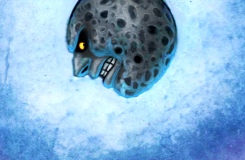
Throughout all this, Skull Kid hides his face behind Majora’s Mask. He presents this strong, hateful face to the world so that no one can notice his many insecurities. He keeps his soul hidden from the world, and thus he allows it to fall prey to the demon Majora. He ceaselessly contemplates how his friends abandoned him and how the world rejected him. No one can offer him comfort, support, or sympathy because he doesn’t have the strength of heart to show anyone his true, suffering face. The only voice he hears is that of Majora, the enemy of faith. Majora attacks Skull Kid’s unhealed scars, reminding him of all the pain the world has caused him. In his isolation and loneliness, Skull Kid allows his fears and doubts to grow larger and larger until they swallow him and the demon Majora takes control. Majora then targets the world of Termina, summoning the Moon down from the heavens to spread fear and doubt across the land before destroying it.
“I…I shall consume.
Consume…Consume everything.”
—The Moon, possessed by Majora
Termina, however, is saved by Tatl and Link, who go into the mouth of the Moon in a tremendous act of faith. They destroy Majora and the Moon vanishes, leaving behind a rainbow. Skull Kid, his face unmasked, speaks with the Giants.
“You guys… You hadn’t forgotten about me?
You still thought of me as a friend?”
—Skull Kid
All this time, Skull Kid had been unable to trust the friendship of the Giants, and it was this weakness that had originally marred the world of Termina. But Skull Kid’s friends save him from his self-destruction and forgive his misdeeds. The rainbow in the sky appears to show that the Goddesses have forgiven the world of Termina. The wounds have been healed, and the land is redeemed(6).
(6) [But not everything is well in the end. Skull Kid’s loss of faith led to the deaths of Mikau, Darmani, and the Deku Butler’s son, and these tragedies cannot be undone.]
“Just Have Faith…”
Nintendo Power: “Is there anything you weren’t able to accomplish in Ocarina of Time that you have included in Majora’s Mask?”
Shigeru Miyamoto: “Yes. In fact, that is why we’ve decided to base the game on three-day intervals. This allows gamers to see characters as they go through their daily routines in more detail. Depending on which time of day you visit a particular character, he or she will be doing different things and that may reveal essential clues to the mystery that is at the heart of the game. To conquer the game and solve the mystery, players must learn all about the many characters and discover new masks.”
—Nintendo Power Vol. 134
Majora’s Mask was designed to achieve some of the things Ocarina of Time wasn’t able to accomplish. Specifically, the Zelda team wanted to flesh out the character interaction. If you revisit Ocarina of Time, you’ll notice that Nintendo made an effort to give some depth to many of the side characters in the game. Most of this was done through two major side quests: the mask trading sequence and the Biggoron Sword trading sequence, both of which built off the trading sequence concept as introduced in Link’s Awakening.
Each time you obtained a new mask or trading item, you had to figure out which character in the game would be interested in it. As you interacted with characters such as the Cucco girl and her brother or the Kakariko guard, you’d learn a little more about their families and their personal struggles. As you traded with them, you’d often help them to find greater happiness.
Sound familiar? When Nintendo was developing the premise for Majora’s Mask, it seems they focused on the dynamics of these two quests and how they could really flesh them out in a new game. Certainly, the role of the masks in Ocarina of Time heavily influenced the design of the sequel, and thus the Happy Mask Salesman would be important to the new game. Now, if you look at the Salesman’s dialogue in Ocarina of Time, you’ll notice that there is one line he repeats again and again: “Just have faith…”
Mr. Miyamoto mentions that there is some mystery at the heart of Majora’s Mask, something important that the player must discover on his own. I believe this philosophy, to always have faith, is the message that is at the heart of the game. It seems the Zelda team tried to convey this message in Ocarina of Time, but then decided they could do a much better job of it by building a game that would revolve around the idea.
The theme of faith and doubt is reflected in so many aspects of Majora’s Mask, big and small. To win the dog-racing minigame, you must seek out the dogs that believe in themselves. To help out people, you need to trust their promises and keep your own promises.
To complete any Deku Flower challenge, you must have the patience to wait until the opportune moment and the confidence to believe that you can fly to your destination. To reach the end of the Goron Moon dungeon, you need to trust the game enough to let go of the control stick and let the rolling Goron bounce off the chests in a straight line. To find the child hiding in the Zora Moon dungeon, you must not worry when you do not succeed on your first, second, or even third attempt. As the owl cautioned you, things rarely go well at first, and impatience leads only to frustration and failure.
The land Ikana is overrun by the frightful spirits of the dead, but at the center of this kingdom is the boldly colorful Music Box House. It belts out a cheerful carnival tune that causes the Gibdos lurking outside to be swallowed by the earth.
After helping the troubled people of Termina and gaining all the masks, you receive the Fierce Deity Mask, a representation of the faith you instilled in everyone. With this power you can completely obliterate Majora, the representation of doubt.
In the streets of Clock Town, the two twin jugglers play around and make jokes about several disturbing events.
“You see, we’re entertainers. We must keep people smiling. No matter how grim things get, we must always be optimistic!”
—The Jugglers
The game argues that you must believe in your strengths and believe in your friends and walk a confident path of hope. If you allow your fears and doubts to grow uncontrollably, they threaten to swallow you just as the Deku Scrub swallowed Link in his dream, and just as the Moon tried to swallow Termina.
But simple faith won’t solve every problem. Even if Anju waits patiently in her room for Kafei, her fiancé won’t necessarily return to her.
“Anju stayed in her room to wait for Kafei…
It’s foolish to believe a man like that.
I too believed my husband would return out of the blue…
Oh, Anju…
That child’s naive sense of trust may be my fault.”
—Anju’s mother
Faith won’t change circumstances. It won’t make it so that suddenly everything goes well and all your friends start living up to your expectations. But having faith allows you to go through your struggles with a clear mind and a strong heart. Without any strength of heart, a decent person could end up in something resembling Skull Kid’s tragic situation. Those without faith may try to run from their troubles, only to find that they cannot escape them.
“Forgive your friend.”
—The Eastern Giant
Friends won’t always be there for you, and they will at times disappoint you. To address this issue, Majora’s Mask also emphasizes the importance of forgiveness. As Igos du Ikana pointed out, believing in your friends means that you are willing to see past their failures.
When Kafei finally returns to Anju after his month-long absence, he raises his arm defensively and apologizes for being late. But instead of unleashing a storm of anger on him, Anju simply says, “Welcome home.”

Making Towers to Heaven
“You have a frightful mask. But being able to see into people’s hearts and minds seems useful…”
—The Happy Mask Salesman
Early in this article, I mentioned that the Stone Tower is likely an allusion to the Biblical story of the Tower of Babel. The people of Termina tried to build a tower that would reach the heavens. The Goddesses disapproved and foiled their plans, and afterwards Termina was a cursed land.
In the Biblical story, people tried to build a tower that would reach Heaven. God disapproved and foiled their plans. Afterwards, each person spoke a different language, and cooperation seemed to become impossible. Mankind had become divided.
Though the people of Termina do not all speak different languages, they are similarly divided when Link enters their land. They do not understand the hearts of their friends. They lose faith in their friends. They grow suspicious of each other. They bicker with each other. They seek vengeance when they are wronged. They become lonely and isolated. They keep secrets.
They hide their faces under masks.
“Your friends…What kind of…people are they?
I wonder…Do those people…think of you…as a friend?”
“You…What makes you…happy?
I wonder…What makes you happy…Does it make…others happy, too?”
“The right thing…What is it?
I wonder…If you do the right thing…Does it really make…everybody…happy?”
“Your true face…What kind of…face is it?
I wonder…The face under the mask…Is that…your true face?”
—The Masked Children
“I shall meet you again…”
When Majora’s Mask opens, Link is in the middle of a long journey in search of his beloved and invaluable friend. But when the Moon vanishes from the skies of Termina, Tatl mentions that both she and Link have found what they were seeking(7). At that point, the Happy Mask Salesman offers Link these words:
“Shouldn’t you be returning home as well?
Whenever there is a meeting, a parting is sure to follow. However, that parting need not last forever…
Whether a parting be forever or merely for a short time…That is up to you.”
—The Happy Mask Salesman
The game ends as Link is riding through the forest once more. Perhaps he is continuing his search for his departed friend, but there is a chance that he is heading somewhere else.
When Princess Zelda bid farewell to Link, she said that she believed in her heart that the day would come when they would meet again. And both Tatl and the Salesman believe that Link has found that which he was truly seeking. His journey has come to a close, and it is time for him to return home.
“…Everyone has gone away, haven’t they?”
—Child wearing Majora’s Mask
Long ago, the Four Giants departed and left behind their friend Skull Kid. Skull Kid was torn. He didn’t understand why his friends left, and he didn’t believe that they would ever be there for him again. In his loneliness, he lost all faith.
At the end of Ocarina of Time, Link’s longtime friend departed as well. He didn’t know why she left, where she had gone, or whether he would ever meet her again. In his loneliness, Link begins a long journey in search of her. But the search is fruitless and as Link nearly loses all hope, his desperation is the only thing keeping him going.
But Zelda’s close friend had also departed. She didn’t know where he would go or how long he would be away, but she believed that she would one day see him again. In his absence, she waits patiently and prays for him. And when the time is right, the Happy Mask Salesman reminds Link that there is someone back home awaiting his return.
And so Link returns home, having found what he was after. And he trusts that one day his beloved and invaluable friend will return to him.
(7) [If you decide to replay Majora’s Mask, pay close attention to the development of Tatl’s character. It illustrates very well the overall message of the story. She wears her own mask to hide her insecurities, but there are times when she tries to remove that mask and reveal her true feelings. She typically acts snide and sarcastic towards Link, but at one point she apologizes for her actions, and towards the end she even admits to admiring Link. Tatl’s close friend viciously betrays her, and she watches as that friend abuses her brother. Again and again, she declares that she will never forgive Skull Kid. Throughout the game we see her doubting her brother Tael, but Tael reveals his strength of heart during the final confrontation atop the Clock Tower. Tatl draws strength from Link and Tael and is able to find her own sense of faith.]